


Is a Lithium Marine Battery Worth the Money?

Lithium marine batteries cost several times more than lead-acid at the register, and every boater considering one asks the same thing: is a lithium marine battery worth it? The honest answer is that it depends on how hard you use the battery, how much weight matters on your boat and what else in your system needs to change. This article walks through the costs and benefits so you can decide with real numbers instead of marketing claims.
What you actually get for the money
More usable energy per rated amp-hour
A lead-acid battery lasts longest when you regularly use only about half of its rated capacity. LiFePO4 batteries are commonly rated for much deeper discharge. So a 100Ah lithium battery typically delivers far more everyday energy than a 100Ah AGM. If you’re comparing a lithium battery to the lead-acid battery it would replace, compare usable watt-hours, not the number on the label.
Steady voltage
Lithium holds its voltage near nominal through most of its discharge. A trolling motor keeps its speed late in the day, and electronics don’t flicker. For tournament anglers, that alone can justify the price.
Weight
The store’s Battle Born 100Ah 12V is listed at 31 lb. A Group 31 AGM such as the Trojan 31-AES is listed at 69 lb. Multiply that by two or three batteries and the difference shows up in planing speed, fuel burn and trailer handling.
Cycle life
Many LiFePO4 batteries are rated for thousands of cycles. Dakota Lithium lists up to 80% capacity after 5,000 cycles in recommended conditions for many models, and EPOCH lists 4,000+ cycles for its Essential series. Lead-acid deep-cycle batteries are usually rated for hundreds of cycles at moderate depth, with the exact figure depending on the model and how deep you go.
Low maintenance
No watering, no equalizing and no acid residue. You still keep terminals clean and tight.
What it really costs
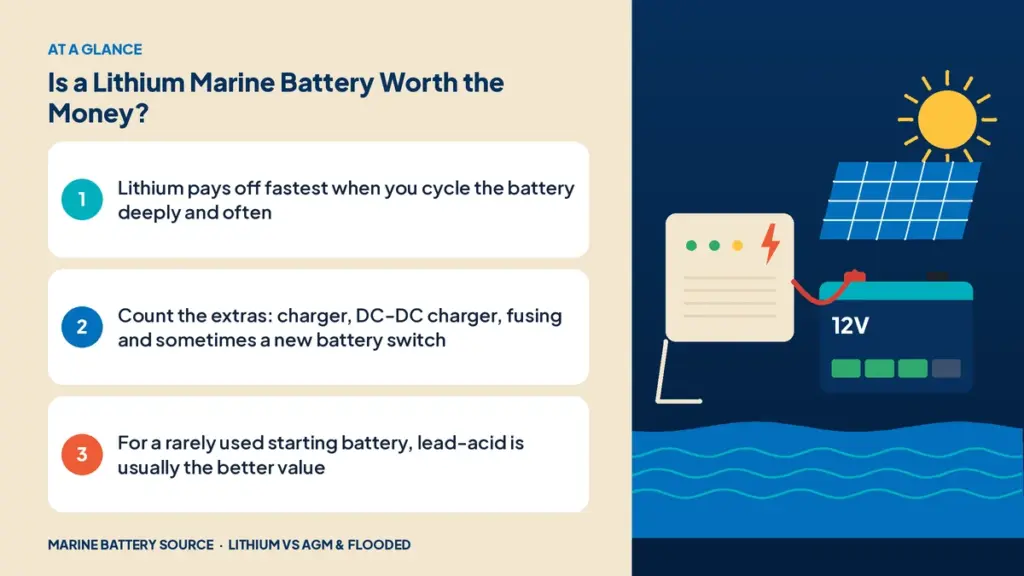
The battery is only part of the bill. Before you decide, price out:
- A lithium-compatible charger. Many older lead-acid chargers don’t have a lithium profile. Options range from single-bank units to multi-voltage models like the EPOCH 12V and 36V onboard charger.
- Alternator protection. If the engine will charge the lithium battery, you may need a DC-DC charger.
- Proper fusing. Lithium can deliver very high short-circuit current, so fuse ratings and placement matter.
- Mounting hardware. A lighter battery can need a different tray or hold-down.
A simple payback framework
Here’s a way to think about value without inventing numbers.
- Write down the lithium battery’s price and the price of the lead-acid battery you’d otherwise buy.
- Estimate how many years each will last for you. Lead-acid life depends heavily on depth of discharge, heat and charging habits. In hot climates and hard use, it’s often shorter than people expect.
- Divide price by expected years for each. Then add the cost of any charger or wiring changes to the lithium side.
- Ask what the weight savings and steady voltage are worth to you on the water.
If you’d replace your lead-acid batteries two or three times during the lithium battery’s expected life, the lithium often comes out ahead even before you count weight and performance. Our cost-per-cycle guide goes deeper into that math.
When lithium is usually worth it
- Trolling motor banks that get cycled deeply on most trips. This is the classic case.
- Bass, bay and multi-species boats where weight affects speed and fuel.
- Kayaks, canoes and small skiffs where every pound matters and you carry the battery.
- House banks on cruising boats that cycle daily and need fast recharge from limited charging time.
- Boats in hot climates where lead-acid life suffers. Heat isn’t good for any battery, but lead-acid tends to lose life faster.
When lead-acid is usually the better buy
- A starting battery that gets shallow, short cycles and is recharged by the engine right away. A good flooded or AGM starting battery is inexpensive and well matched to alternator charging.
- Boats used a few times a year where batteries age out from time rather than cycles.
- Systems you can’t upgrade with lithium-ready charging.
- Very cold storage and charging without a heated battery. LiFePO4 must not be charged below freezing unless it has internal heating.
The middle path
Many boaters convert in stages: a lithium trolling bank first, while keeping a lead-acid starting battery. That gets the biggest benefits for the least system change. The process is laid out in our step-by-step lithium conversion guide. Keep chemistries in separate banks with separate charging, because mixing them in one bank causes problems.
Questions to ask before you buy
- What job will this battery do, and how deep will I discharge it on a typical trip?
- How will it be charged at the dock and on the water?
- Does my charger have a LiFePO4 profile?
- Will I charge in freezing weather?
- Does it fit my compartment, and are the terminals in the right place?
- What does the warranty cover, and for how long?
If you’re still weighing the chemistries, our lithium vs AGM vs flooded chemistry guide lays out the trade-offs side by side, and the lithium buyer’s guide covers features like Bluetooth and heating. Browse the full lithium battery collection when you’re ready to compare models.
Frequently asked questions
How long does a lithium marine battery last?
Many LiFePO4 marine batteries are rated for thousands of cycles. Real-world life also depends on heat, charging and storage. Check each battery’s cycle-life rating and warranty.
Is lithium worth it for a starting battery?
Usually not on a typical outboard, where a lead-acid starting battery is cheap and cycles shallowly. It can make sense when weight matters or when one dual-purpose lithium battery replaces two lead-acid batteries, as long as your engine maker supports it.
Do I need a new charger for lithium?
If your charger lacks a lithium or LiFePO4 profile, yes. Charging lithium on a lead-acid profile can undercharge it or apply settings, such as equalization, that aren’t suitable.
Will lithium make my trolling motor faster?
Not faster at full throttle beyond what the motor is designed for, but lithium’s steady voltage means the motor keeps its speed for more of the day instead of slowing as the battery drains.