


BCI Battery Group Sizes Explained for Boat Owners
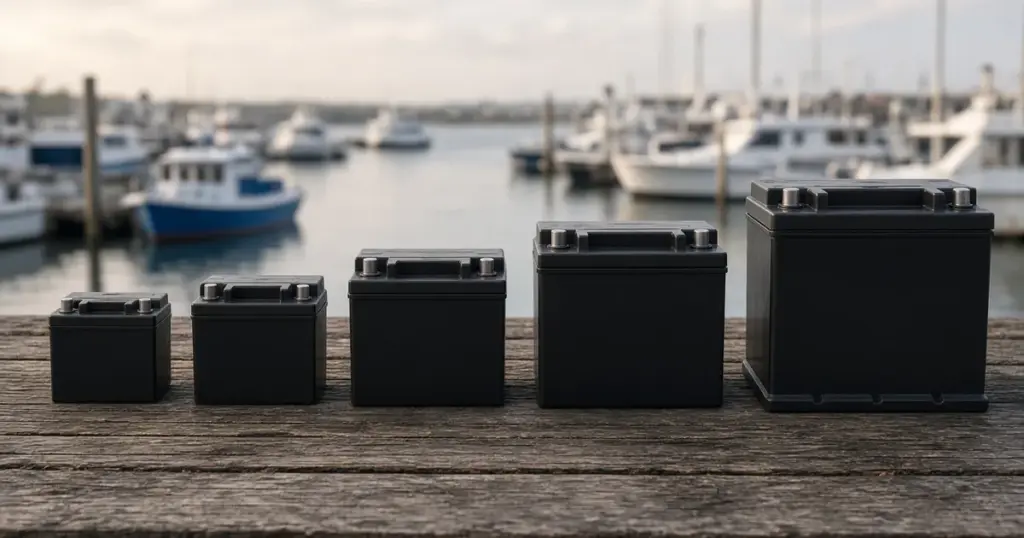
Look at almost any marine battery listing and you’ll see a code like Group 24, 27M or 31. These are BCI group sizes, a standard set of battery case sizes published by Battery Council International. Understanding them makes it much easier to find a battery that fits your tray, box or compartment. This guide explains what BCI group sizes mean, which ones are common on boats, and how to use them, along with why the group number alone isn’t the whole story.
What a BCI group size tells you
A BCI group size primarily describes a battery’s physical case dimensions, its length, width and height, within a tolerance. Many group sizes also have a typical terminal type and layout associated with them. The group size does not define a battery’s capacity, cranking amps, chemistry or quality. Two Group 31 batteries can have very different ratings.
Think of the group size as the “shoe size” of a battery: necessary for fit, but it tells you nothing about performance.
Common marine group sizes
Here are the sizes you’ll see most often on boats, from smaller to larger. We’re describing them in relative terms; always check the exact dimensions on the product page.
Group 24 / 24M
One of the most common marine sizes. You’ll find it on smaller boats, as a starting battery, and in many trolling motor setups. Examples include the Interstate 24M-XHD starting battery and the Trojan 24TMX deep cycle battery. Many 12V lithium batteries are also built on a Group 24 footprint.
Group 27 / 27M
Longer than a Group 24, with room for more capacity. It’s a very popular choice for deep-cycle trolling and dual-purpose use. See the Interstate 27M-AGM and Trojan 27TMX.
Group 31 / 31M
Longer still, and common for larger dual-purpose and deep-cycle batteries. Group 31 batteries often use threaded stud terminals. Several native 24V and 36V lithium trolling batteries use a Group 31M-style case, like the Interstate LI31M36V50.
Group 34 / 34M
A shorter, squatter case, popular for high-cranking AGM dual-purpose batteries where space is tight. See the Interstate 34M-AGM.
Group 4D and 8D
Large, heavy 12V batteries for bigger boats with large engines or house loads. Examples include the Interstate SRM-4D and Trojan 8D-AGM. Lithium replacements for 8D-size compartments can save an enormous amount of weight.
GC2, GC2H, GC3
“Golf cart” sizes. GC2 is the classic 6V deep-cycle footprint, like the Trojan T-105. GC2H is a taller version. Pairs of GC2 batteries in series make a popular 12V house bank. Some 12V lithium batteries are built on GC2 and GC3 footprints to drop into those spaces, like the Battle Born GC2 and Battle Born GC3.
902, 903, 921, 30H
Less common deep-cycle sizes, used by some heavy-duty 6V and 12V batteries, such as Trojan’s J305 (902), L16 (903) and J185H (921) families, and the SCS225 (30H).
What does the “M” mean?
An “M” suffix, as in 24M, 27M or 31M, indicates a marine version of that group size. Marine batteries in these sizes often feature dual terminals, with threaded studs plus automotive-style posts, and they’re built for the vibration of marine use. The case footprint is similar to the non-M size, but always compare actual dimensions and terminal layout.
Other letters you might see
Automotive group sizes sometimes include letters for terminal position or height. For example, an “R” often indicates reversed terminal polarity, and “H” a taller case. Conventions vary, so treat suffixes as a hint and confirm the details on the product page.
Why the group size isn’t enough
- Tolerances: batteries in the same group can differ slightly in dimensions, especially height and handle design. Tight compartments, or lids that close over the battery, can make a small difference matter.
- Terminal type: threaded studs, SAE posts or both. Your cable ends need to fit.
- Terminal position and polarity: if positive and negative are reversed from your old battery, cables may not reach.
- Lithium cases: many lithium batteries are designed on a BCI footprint, but some differ in height or terminal location.
- Hold-downs and trays: make sure your existing tray, strap or bracket fits the new battery. Model-specific trays are in Accessories.
How to measure for a replacement
- Read the old battery’s label for its group size, CCA or MCA, capacity and chemistry.
- Measure the compartment: length, width and height. Note any lid, strap or bracket that limits height.
- Note terminal type and position: take a photo looking down at the battery, with the terminals visible.
- Check cable reach if you’re considering a battery with a different terminal layout.
- Compare with the dimensions and terminal details on each product page.
A quick example
Say your boat has a Group 27 dual-purpose battery with threaded studs, and the compartment has a strap over the top. Before you order, measure the compartment and the strap’s reach. Note which side the positive terminal is on, and check whether your cable ends are ring lugs for studs or clamps for posts. With those details, you can compare any Group 27 battery, or a lithium battery on a Group 27 footprint, and know it’ll drop in. If you’re also changing chemistry, set your charger to the new battery’s profile.
Changing sizes
Moving up a size, say from Group 24 to Group 27, usually gets you more capacity, if the compartment and tray allow. Moving to lithium can let you get more usable energy from the same footprint, or the same energy from a smaller one. A native 24V or 36V lithium battery can replace two or three Group 24 or 27 batteries with a single case. See choosing a trolling motor battery and converting a boat to lithium.
Shop by size and job
Use our shop filters to narrow by capacity, voltage and chemistry, then check the dimensions on each product page. Start with Cranking, Dual Purpose, Trolling Motor or House Bank. Not sure what fits? Send us your old battery’s label and your measurements. Anywhere from Venice to Gainesville, FL, we’ll measure and install for you.