


Charging Lithium Batteries on a Boat: Onboard Chargers, Alternators and DC-DC
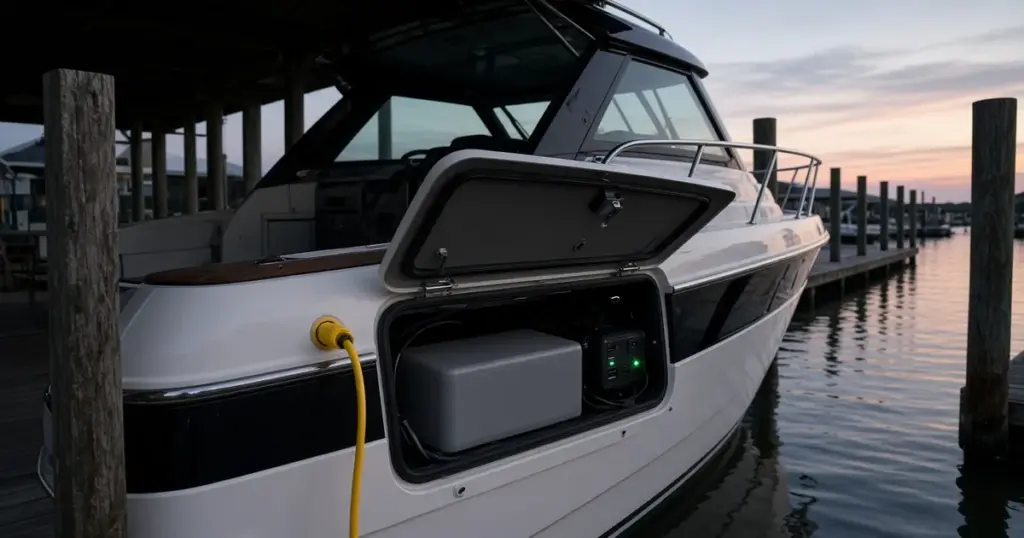
LiFePO4 batteries are easy to live with once they’re charged correctly, and that’s the part many conversions get wrong. Lithium needs a different charge profile than lead-acid, and it behaves differently on an engine alternator. This guide covers the three main ways of charging lithium batteries on a boat: onboard (shore power) chargers, the engine’s alternator, and DC-DC chargers. It also covers solar, cold weather and storage.
Always follow your battery manufacturer’s charging specifications. They override anything general here.
How lithium charging differs from lead-acid
- Different voltages: LiFePO4 has its own charge voltage targets, which differ from flooded and AGM.
- No float needed: lead-acid likes to be held at a float voltage, while lithium doesn’t need it. Many lithium profiles stop charging or hold a lower voltage once the battery is full.
- No equalization: the high-voltage equalize stage used on some flooded batteries is not suitable for lithium.
- Fast acceptance: lithium can accept high current for most of its charge, so it recharges quickly. That’s great with a good charger, but it can overwork an alternator.
- Temperature limits: LiFePO4 shouldn’t be charged below freezing unless it has internal heating. The BMS will typically block charging when it’s too cold or too hot.
- BMS protection: the battery management system can disconnect the battery to protect the cells. Your charging system should handle that safely.
Method 1: Onboard (shore power) chargers
An onboard charger plugs into shore power and charges your batteries at the dock or on the trailer. For lithium, it needs a LiFePO4 or lithium profile.
Can I keep my old charger?
Possibly. Many modern chargers have a selectable lithium mode. Check the manual, and compare its voltages with your battery maker’s specs. If your charger is lead-acid only, or has an automatic equalize or desulfation mode you can’t turn off, replace it.
Choosing a lithium onboard charger
- Voltage and banks: match the charger to how your batteries are configured. A native 36V battery needs a 36V charger, like the Dakota Lithium 36V 20A onboard charger or the EPOCH 36V 15A charger. A series bank of 12V batteries is often charged one battery per bank with a multi-bank charger, like the EPOCH 4-bank 12V marine charger.
- Mixed boats: if you have a lead-acid or lithium 12V starting battery and a 36V lithium trolling battery, a combination unit like the EPOCH 12V and 36V onboard charger handles both.
- Charge rate: a higher-amp charger refills faster. Stay within the battery’s maximum charge current. A rough recharge time is amp-hours to replace divided by charger amps.
- Marine build: look for a sealed, waterproof housing for on-board mounting.
Browse all marine battery chargers.
Method 2: The engine alternator
Outboards and inboards have alternators that charge the starting battery while the engine runs. Connecting a lithium bank directly to that system raises a few issues:
- Heat and load: a depleted lithium battery can pull as much current as the alternator can make, for a long time. Many alternators aren’t designed for sustained full output and can overheat.
- Voltage regulation: the alternator’s regulator is set for lead-acid. It may undercharge lithium, or it may not match lithium’s needs.
- BMS disconnects: if a lithium battery’s BMS suddenly disconnects while the alternator is charging it, the voltage spike can damage the alternator or electronics.
- Small outboard charging circuits: some outboards have limited charging output, and engine makers may have specific guidance about lithium.
Some lithium batteries, especially cranking-rated and dual-purpose models, are designed to work with typical engine charging systems. Check both the battery and engine manufacturers’ guidance before you rely on direct alternator charging.
Method 3: DC-DC chargers (charge on the run)
A DC-DC charger is the most common way to charge a lithium bank from an engine safely. It connects between the starting battery (and alternator) and the lithium bank, and it:
- limits the current drawn from the alternator, protecting it from overheating;
- applies a correct lithium charge profile to the house or trolling bank;
- isolates the banks, so house or trolling loads can’t drain the starting battery;
- can step voltage up, charging a 24V or 36V trolling bank from a 12V engine system.
Examples include the EPOCH 12V to 36V marine DC-DC charger, which tops up a 36V trolling battery while you run, and the EPOCH dual-output 12V/36V DC-DC charger.
Sizing a DC-DC charger
Choose a current rating your alternator can comfortably supply alongside the engine’s own needs. Then estimate how many amp-hours it’ll put back during a typical run. A DC-DC charger won’t refill a big bank on a short run, but it adds up across a day of running between spots.
What about isolators and ACRs?
Automatic charging relays (ACRs) and battery isolators connect banks when the engine is charging and separate them when it’s not. They work well for lead-acid house batteries. With lithium, a plain ACR doesn’t limit current or apply a lithium profile, so check the battery manufacturer’s guidance. Some combine an ACR with a lithium battery designed for it, like the Dakota Lithium outboard dual battery isolator/ACR kit. For switch basics, read battery switch basics.
Solar charging
Solar is a great way to keep a house bank topped up at anchor or on a mooring. Use a charge controller with a LiFePO4 profile, or one with adjustable settings that match the battery maker’s specs. Fuse both the panel input and the battery output, as the controller’s manual specifies.
Charging in cold weather
LiFePO4 can be discharged in cold weather, but it shouldn’t be charged below freezing unless the battery has internal heating. Heated models, like the Dakota Lithium DL+ 12V 135Ah heated and the ECO Battery 12V 120Ah heated, warm the cells before accepting charge. Unheated batteries rely on the BMS to block charging when it’s too cold. Check the manufacturer’s charge-temperature range.
Charging for storage
Don’t store lithium at full charge on a charger for months unless the manufacturer says to. Many recommend a partial state of charge, all loads disconnected, and a check-in every so often. See our winter storage guide.
Checklist for charging lithium batteries on a boat
- Every charging source is set to a lithium profile: shore charger, DC-DC and solar.
- No equalize or desulfation modes are active on lithium.
- The alternator is protected, by DC-DC charging or a manufacturer-approved method.
- Charge current is within the battery’s limit.
- Fuses are on every charger output near the battery.
- Cold-charging protection is in place: heated batteries or BMS lockout.
- Monitoring is in place, through the battery’s app or a shunt-based monitor.
Want help designing a charging system? If you’re between Venice and Gainesville, FL, our local installation team can install chargers, DC-DC systems and lithium batteries. Everywhere else, we ship nationwide. Start with converting a boat to lithium or browse lithium marine batteries.