


Trojan T-105 vs T-125 vs T-145 6V Batteries
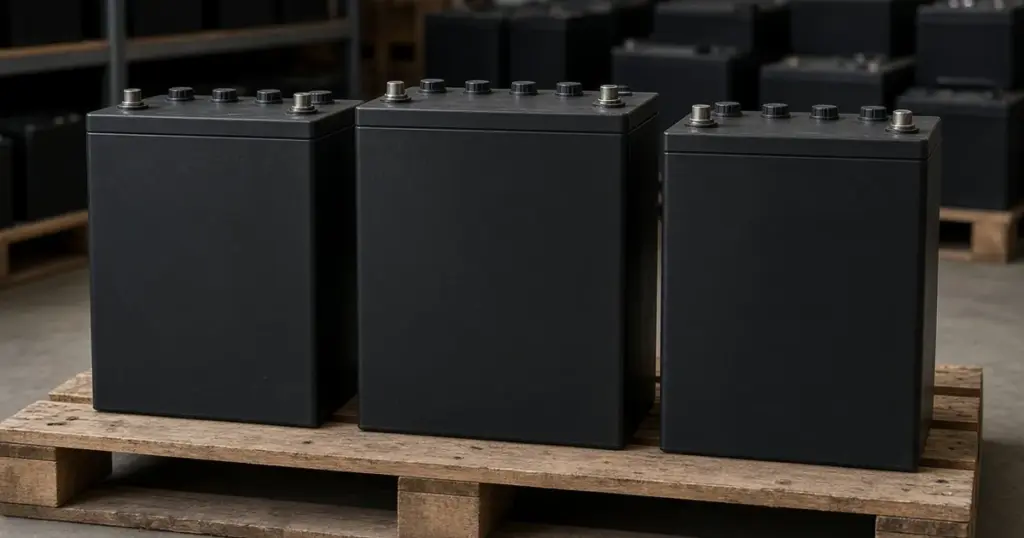
Six-volt golf-cart batteries are a classic choice for boat house banks. Wired in pairs to make 12V, they offer lots of capacity and durable deep cycling at a reasonable price. Trojan’s T-105, T-125 and T-145 are the best-known models. This guide compares them using our product listings and explains how to choose and install a pair on a boat. Check product pages for current specs and stock.
The short version
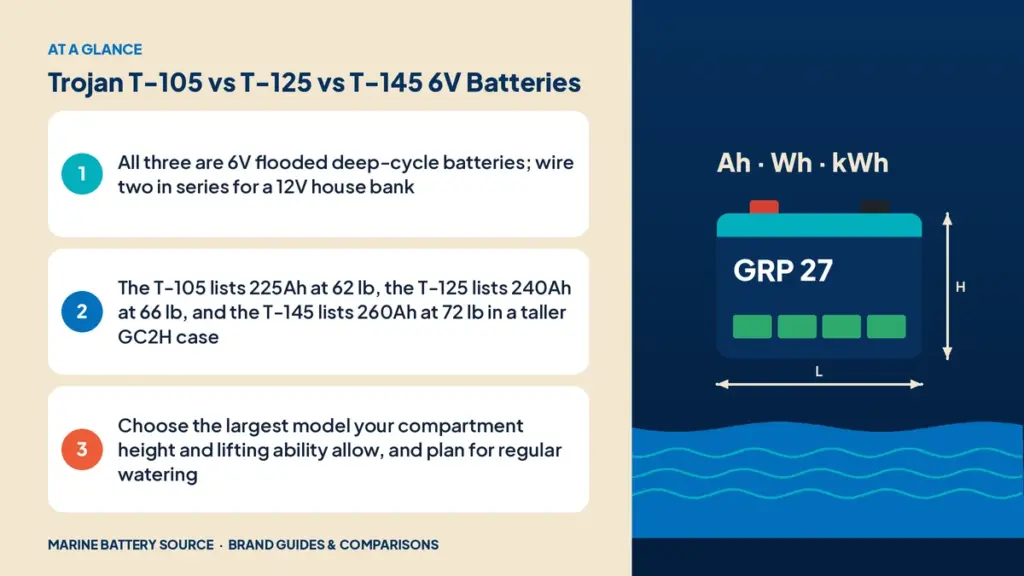
- T-105: 225Ah, 62 pounds, standard GC2 height. The proven default.
- T-125: 240Ah, 66 pounds, same GC2 footprint. A bit more capacity in the same space.
- T-145: 260Ah, 72 pounds, taller GC2H case. The most capacity, if you have the headroom.
Side by side
| T-605 | T-105 / T-105 Plus | T-125 / T-125 Plus | T-145 / T-145 Plus | |
|---|---|---|---|---|
| Voltage | 6V | 6V | 6V | 6V |
| Capacity (20-hr) | 210Ah | 225Ah | 240Ah | 260Ah |
| Reserve capacity @ 25A | 383 min | 447 min | 488 min | 530 min |
| Weight | 58 lb | 62 lb | 66 lb | 72 lb |
| Case | GC2 | GC2 | GC2 | GC2H (taller) |
| Chemistry | Flooded | Flooded | Flooded | Flooded |
Trojan also offers the T105 AES, an AGM version listed at 240Ah and 89 pounds, for owners who want a sealed battery in the GC2 size.
Why 6V batteries for a 12V boat?
Two 6V batteries in series make a 12V bank with the capacity of one battery. A pair of T-105s gives a 12V 225Ah bank. Golf-cart batteries are built for daily deep cycling, with thick plates that tolerate repeated discharge better than many 12V marine batteries. They’re also common and competitively priced, which is why they’re popular for house banks on cruising boats.
The trade-offs: they’re heavy, need regular watering, must be installed upright and ventilated, and a pair takes more space than a single 12V battery of similar capacity.
Capacity and usable energy
For long life, flooded batteries should generally be cycled to about 50% state of charge. That means:
| Bank (2 batteries in series) | Rated 12V capacity | Usable at 50% |
|---|---|---|
| T-605 pair | 210Ah | ~105Ah |
| T-105 pair | 225Ah | ~112Ah |
| T-125 pair | 240Ah | ~120Ah |
| T-145 pair | 260Ah | ~130Ah |
For more capacity, add a second pair in parallel. Four T-105s make a 12V 450Ah bank with about 225Ah usable.
Height: the deciding factor
All of these share a similar footprint, but the T-145’s GC2H case is taller. Before choosing the T-145, measure the height available in your battery box, including clearance for cables, caps and a hold-down strap. You also need room above the caps to check and add water. If the taller case fits, the T-145 gives the most capacity per footprint. If not, the T-125 is the best choice in standard GC2 height.
Weight
A pair ranges from 116 pounds (T-605) to 144 pounds (T-145). That weight should sit low and near the boat’s centerline. Each battery also has to be lifted into place, so think about access, especially in deep lockers. If weight is a serious concern, a single LiFePO4 battery can replace a pair of 6V batteries at a fraction of the weight.
“Plus” versions
The Plus versions of the T-105, T-125 and T-145 list the same capacity and weight as the standard models in our listings. Trojan’s Plus models use a different design; check the product pages and Trojan’s literature for details.
Wiring a pair to 12V
- Place both batteries in a secure, ventilated box.
- Connect the positive terminal of battery A to the negative terminal of battery B with a short, heavy jumper cable.
- The free negative on battery A is the bank’s negative; the free positive on battery B is the bank’s positive.
- Fuse the bank’s positive lead close to the battery.
- Set your charger to a flooded profile at 12V.
For two pairs, wire each pair in series first, then connect the pairs in parallel, taking the main positive and negative from opposite corners of the bank to balance the load.
Maintenance
Flooded batteries need distilled water. Check levels monthly in hot weather, after equalizing, and whenever you charge often. Keep the plates covered, but don’t overfill. Clean terminals and check jumper connections for tightness. Many owners add a single-point watering system to make this easier in tight compartments. Follow Trojan’s guidance on equalization, and only equalize flooded batteries, never AGM or lithium.
Charging
Golf-cart batteries like a full charge after every use. A multi-stage marine charger with a flooded profile works well. If the boat sits for long periods, keep the bank on a float charger or disconnect it and check voltage monthly. A flooded 12V bank reads about 12.6–12.7V at rest when fully charged and about 12.2V at 50%.
Warranty
Our Trojan listings don’t show warranty terms, so check Trojan’s own terms for these models.
How they compare with lithium
A pair of T-105s gives about 112Ah usable at 124 pounds. A single 12V 100Ah LiFePO4 battery delivers about 80–100Ah usable at roughly 21–31 pounds, with no watering and no venting requirements. Lithium costs more upfront but often lasts longer. Golf-cart batteries remain a good value where weight is less critical and the owner doesn’t mind maintenance.
More reading
For lithium options in the GC2 size, see Battle Born GC2 vs group 27/31. For broader brand comparisons, read EPOCH vs Dakota Lithium, EPOCH Eco vs Essential vs Elite and Dakota Lithium DL dual-purpose. The hubs at marine battery comparisons and marine battery brands compared cover more.
Products mentioned
Frequently asked questions
What’s the difference between the Trojan T-105 and T-125?
Both are 6V GC2 batteries. The T-125 lists 240Ah and 66 pounds; the T-105 lists 225Ah and 62 pounds.
Is the T-145 taller?
Yes. It uses a taller GC2H case. Measure your compartment height before ordering.
How do I make 12V from 6V batteries?
Wire two in series: positive of one to negative of the other. The bank has 12V and the capacity of one battery.
Do Trojan golf-cart batteries need watering?
Yes. The flooded models need distilled water regularly. The T105 AES is a sealed AGM alternative.
Can I mix a T-105 and a T-125 in one bank?
No. Use identical batteries of the same age in a series pair.