


Dakota Lithium DL+ Dual-Purpose Batteries Explained
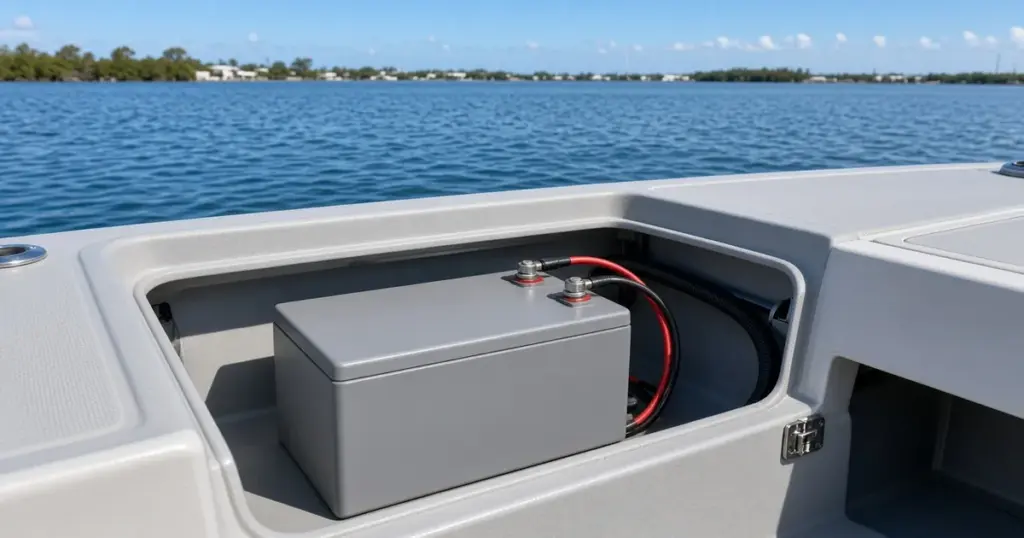
Many small and mid-size boats have room for only one battery, and it has to do two jobs: start the outboard and run the electronics, lights and pumps. Dakota Lithium’s DL+ dual-purpose batteries are built for that. This guide covers the three in-stock 12V models in our store: the 25Ah, 60Ah and 135Ah heated. It explains where each one fits, using our product listings. Check product pages for current specs and stock.
What “dual purpose” means
A cranking battery delivers a big burst of current for a few seconds. A deep-cycle battery delivers steady current for hours and survives repeated deep discharge. A dual-purpose battery does both reasonably well. Lead-acid dual-purpose batteries compromise on both jobs, but LiFePO4 can deliver high current and deep cycling from the same cells. That’s why a lithium dual-purpose battery can replace a separate start battery and house battery on many small boats.
The three models
| DL+ 12V 25Ah | DL+ 12V 60Ah | DL+ 12V 135Ah Heated | |
|---|---|---|---|
| Cold cranking amps | 300 | 1,000 | 1,000 |
| Continuous discharge | 30A | 100A | 135A |
| Weight | 6.4 lb | 16.5 lb | 27.2 lb |
| Group size | Small format | 24 | 24 |
| Energy | 300 Wh | 720 Wh | 1,620 Wh |
| Reserve capacity | Not listed | Not listed | 340 min |
| Internal heating | No | No | Yes |
| Ingress protection | Not listed | Not listed | IP65 |
| Bluetooth | No | No | No |
| Listed warranty | 11 years | 11 years | 11 years |
| Listed cycle life | 5,000 cycles to 80% | 5,000 cycles to 80% | 5,000 cycles to 80% |
DL+ 12V 25Ah: small engines and kayaks
The 25Ah lists 300 CCA and weighs just 6.4 pounds. It suits small outboards with electric start, personal watercraft-size engines, kicker motors and powered kayaks that need a small cranking battery. Its 30A continuous rating limits it for accessories: a fish finder and lights are fine, but it isn’t a trolling motor battery. Always check your engine maker’s minimum cranking requirement before choosing a small battery.
DL+ 12V 60Ah: the single-battery workhorse
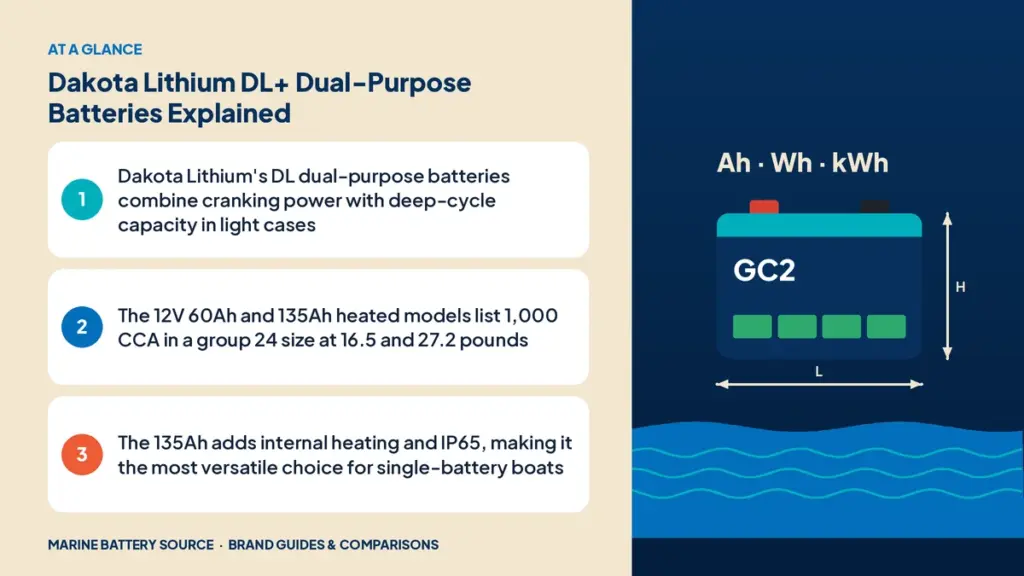
The 60Ah lists 1,000 CCA, 100A continuous and 720 watt-hours in a group 24 size at 16.5 pounds. That’s enough to start most mid-size outboards while running electronics, a livewell pump and nav lights for a full day. It replaces a 45- to 55-pound group 24 lead-acid dual-purpose battery, which is a big weight saving on a small boat.
A good fit for: jon boats, skiffs, small center consoles and pontoons with one battery and modest accessory loads.
DL+ 12V 135Ah Heated: the most versatile
The 135Ah lists 1,000 CCA, 135A continuous, 1,620 watt-hours and 340 minutes reserve capacity, still in a group 24 size at 27.2 pounds. It adds internal heating for cold-weather charging and an IP65 enclosure. With more than twice the energy of the 60Ah, it can run a stereo, a larger fish finder and a livewell all day, and still start the engine.
A good fit for: single-battery boats with heavier accessory loads, northern anglers who fish cold mornings, and owners who want one battery to handle everything. It can also serve as a 12V trolling battery on a small boat, though a dedicated deep-cycle bank is better for heavy trolling use.
Sizing your accessory load
Add up the current draw of everything you run, then multiply by hours of use. A typical small-boat day might look like this:
| Load | Draw | Hours | Amp-hours |
|---|---|---|---|
| Fish finder / GPS | 1.5A | 8 | 12 |
| Livewell pump | 3A (cycling, ~50%) | 6 | 9 |
| Nav lights | 1A | 2 | 2 |
| Stereo (moderate) | 4A | 4 | 16 |
| Total | 39Ah |
That day fits the 60Ah, with reserve for starting. Add a second graph, longer stereo time or an overnight anchor light, and the 135Ah is the safer choice. The outboard’s charging output will put some of that back while you run.
Charging
Use a charger with a LiFePO4 profile. Dakota lists 12V 10A or 20A chargers as recommended for the 60Ah and 135Ah. For charging from the outboard, check that your engine’s charging system works with lithium. Many small outboards have modest charging output that’s fine for a dual-purpose lithium battery, but some owners add a DC-DC charger to protect the alternator and charge more precisely. If you’re unsure, ask your engine dealer or contact us.
Cold weather
LiFePO4 cells shouldn’t be charged below freezing. The 135Ah’s internal heating handles this automatically. The 25Ah and 60Ah lack heating, so in cold weather, charge them indoors or let them warm up first. Dakota lists an operating range of -4°F to 131°F for the 25Ah, so discharge (including cranking) works in the cold, though output drops somewhat at low temperatures.
Installation tips
- Secure the battery in a tray or with a hold-down strap. Dakota sells a group 24 marine battery tray.
- Fuse the positive cable close to the battery for accessory circuits.
- Keep the engine’s cranking cable as short as practical, and use the size your engine maker specifies.
- If you’re replacing a lead-acid battery, update any onboard charger to a lithium profile.
When to choose a two-battery setup instead
If you run a trolling motor, a large audio system or a refrigerator, a dedicated start battery plus a separate deep-cycle bank is usually better. That way, heavy house use can never leave you unable to start the engine. Dual-purpose batteries are best when space or weight allows only one battery and the accessory load is moderate.
More reading
To compare with other dual-purpose and deep-cycle options, see EPOCH Eco vs Essential vs Elite, Interstate lithium vs AGM and Battle Born GC2 vs group 27/31. For flooded lead-acid house banks, read Trojan T-105 vs T-125 vs T-145. Browse marine battery comparisons and marine battery brands compared, and see how to choose a trolling motor battery if you also need trolling power.
Products mentioned
- Dakota Lithium DL+ 12V 25Ah
- Dakota Lithium DL+ 12V 60Ah
- Dakota Lithium DL+ 12V 135Ah Heated
- Dakota Lithium marine battery tray
- Shop all dual-purpose batteries.
Frequently asked questions
Can a Dakota Lithium DL+ battery start my outboard?
The 60Ah and 135Ah list 1,000 CCA and the 25Ah lists 300 CCA. Compare that with your engine maker’s cranking requirement.
Which DL+ model has heating?
The 12V 135Ah Heated lists internal heating. The 25Ah and 60Ah do not.
Is the DL+ 135Ah waterproof?
It lists IP65, which resists dust and water jets. Keep it out of standing bilge water.
What charger should I use?
A LiFePO4 charger. Dakota lists 12V 10A or 20A for the 60Ah and 135Ah.
How much lighter is DL+ than lead-acid?
The 60Ah weighs 16.5 pounds and the 135Ah weighs 27.2 pounds, versus roughly 45–55 pounds for a typical group 24 lead-acid battery.