


Installing a 36V Lithium Trolling Bank in a Bass Boat
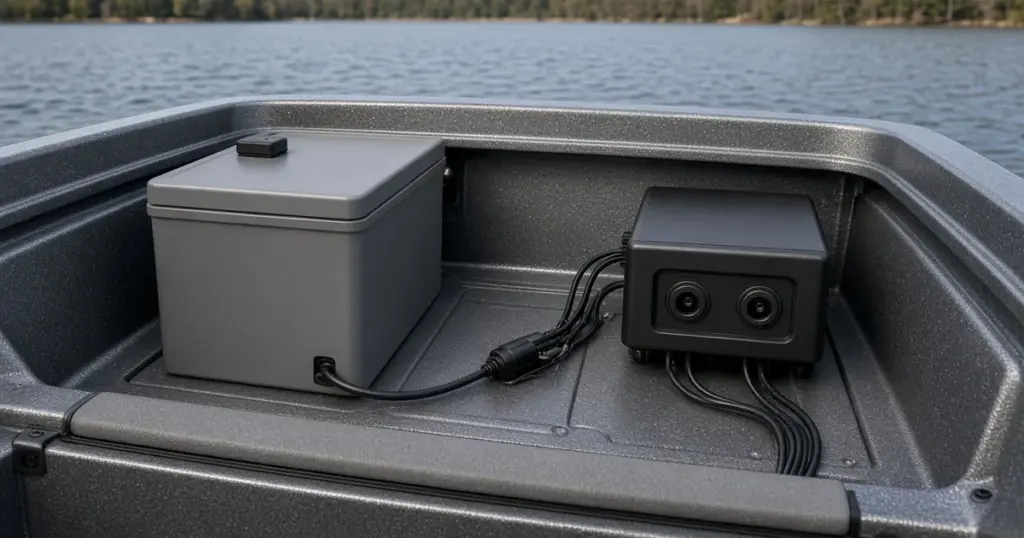
A 36V trolling motor on a bass boat traditionally needs three group 27 or 31 lead-acid batteries, which can weigh 180 to 200 pounds. A lithium conversion can cut that to around 35 to 70 pounds, improve hole shot, and give you full motor power late in the day. This guide walks through a 36V lithium install on a bass boat, from planning to the first tournament.
Planning the conversion
One 36V battery or three 12V?
- Single 36V battery: the simplest layout. Fewer connections, one charger lead, and a lot of saved space. Examples include the EPOCH 36V 50Ah, the EPOCH 36V 100Ah and the Dakota Lithium 36V 60Ah.
- Three 12V lithium batteries in series: more flexibility, the option to use one battery for other tasks, and it works with an existing 3-bank charger. More connections to maintain.
Capacity
- 50Ah to 60Ah: typical for anglers on smaller lakes or who run the motor at moderate speeds.
- 100Ah: for big water, wind and long days at higher speeds, especially with heavy boats.
Compare runtime: three group 31 lead-acid batteries at about 100Ah each offer roughly 50Ah of usable capacity at 36V if you keep them above 50%. A 36V 50Ah lithium can deliver about the same usable capacity, while a 36V 100Ah roughly doubles it.
BMS rating
Confirm the battery’s continuous discharge rating covers your motor’s maximum draw, typically 50A to 56A for many 36V motors.
Tools and materials
- 36V lithium battery or three 12V lithium batteries
- Tray, bracket or filler block
- Breaker or fuse sized per the motor maker (often 60A)
- Cables and lugs sized per the motor maker
- Lithium-compatible charger
- Torque wrench, crimper, multimeter
See marine electrical tools for a full list.
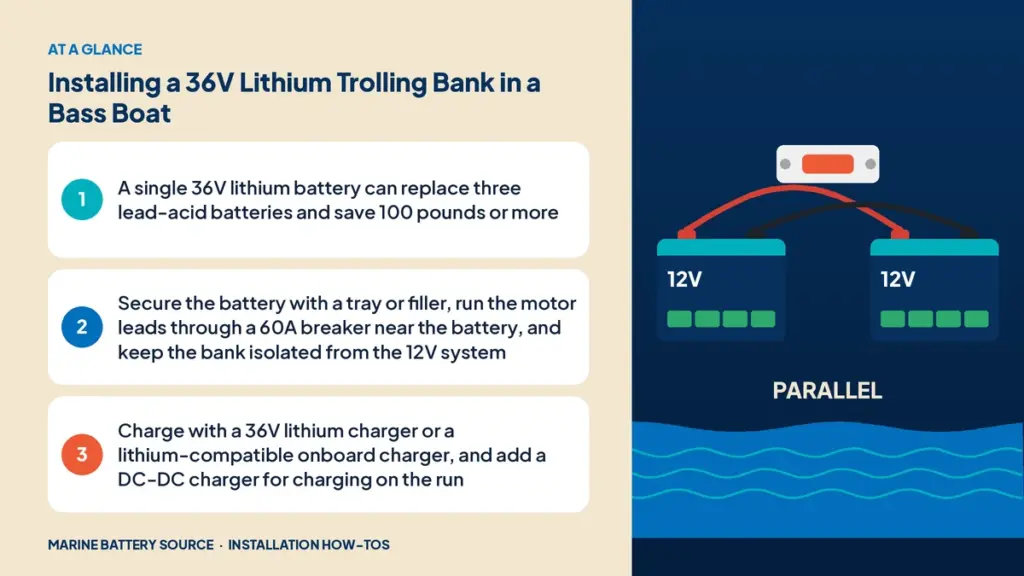
Step 1: Remove the lead-acid batteries
- Unplug the trolling motor and the charger.
- Label all cables.
- Disconnect the motor leads, the series links and the charger leads.
- Remove the hold-downs and lift out the batteries. They’re heavy, so get help.
Step 2: Prepare the compartment
- Clean out debris and inspect the trays.
- Plan how to secure the new battery. A single 36V battery leaves empty space; fill it with a filler block or a tray that fits the battery, so it can’t slide.
- EPOCH offers matched trays, such as the EPOCH 36V 50Ah battery tray.
Step 3: Mount the battery
Set the battery in the tray, secure it with a strap or bracket and confirm it can’t move more than about an inch.
Step 4: Wire the trolling motor
- Install the breaker near the battery.
- Connect the motor positive through the breaker to the battery positive.
- Connect the motor negative to the battery negative.
- Torque to the battery maker’s spec.
For three 12V batteries in series:
- Battery 1 negative to battery 2 positive.
- Battery 2 negative to battery 3 positive.
- Motor positive through the breaker to battery 1 positive.
- Motor negative to battery 3 negative.
Step 5: Keep it isolated
Don’t connect the trolling bank’s negative to the boat’s 12V negative bus, and don’t run accessories from one battery in a series bank. Keep the 36V system separate unless a DC-DC charger requires a shared negative.
Step 6: Charging
- Single 36V battery: use a 36V lithium charger like the EPOCH 36V 15A lithium charger, or an onboard charger with a 36V lithium output, like the EPOCH 12V and 36V onboard charger.
- Three 12V lithium batteries: a 3-bank charger with lithium profiles on each bank.
- On the run: a 12V-to-36V DC-DC charger lets the outboard put charge into the trolling bank while you run between spots.
Step 7: First charge and test
- Charge fully before the first trip.
- Check voltage at the battery (about 40V to 42V when full for 36V LiFePO4, depending on the battery).
- Plug in the trolling motor and test all speeds.
- Check for heat at the breaker and terminals.
Weight savings and performance
Removing 100 to 150 pounds from the back of a bass boat can improve hole shot, top speed and fuel economy. Anglers often notice the boat sits higher in the water and planes faster. Some move weight forward to fine-tune the ride; see how to relocate a boat battery.
Runtime in real fishing
How long a 36V lithium battery lasts depends on how you fish:
- Spot-lock in wind is the biggest drain, often 20A to 40A for long periods.
- Slow cruising along a bank might draw 8A to 15A.
- Running at full speed to a new spot can pull 50A or more, but usually for short bursts.
A 36V 50Ah battery used at an average of 12A gives roughly four hours of active trolling, which stretches into a full day once you factor in idle time, drifting and runs with the outboard. A 100Ah battery doubles that, which is why many anglers who rely on spot-lock in open water choose the larger size. Because lithium holds voltage, the motor’s spot-lock performance stays strong until the battery is nearly empty, unlike lead-acid, where holding position gets harder as voltage drops.
Upgrading cables and connections
A lithium conversion is a good time to check the cables to the bow. Old cables may be corroded inside the insulation, and many factory runs are the minimum gauge. Replacing them with properly sized tinned copper cable and fresh lugs reduces voltage drop and gives you a little more thrust at full speed. Check the trolling motor plug, too; see how to install a trolling motor plug.
Tournament tips
- Use the battery’s Bluetooth app to monitor state of charge.
- Charge each night, even after a short day.
- Carry a small DC-DC charger setup if you fish multi-day events far from shore power.
Cold weather
Most LiFePO4 batteries can’t be charged below freezing unless they have heating. For winter tournaments, consider a heated battery.
Common mistakes
- Using the old lead-acid charger.
- Battery not secured in the oversized compartment.
- Breaker undersized for the motor.
- Mixing old and new batteries in a series bank.
- Running accessories from one battery in the bank.
Other conversions
For pontoons, see pontoon lithium installation. For sailboat house banks, see installing a sailboat house bank. If you’re adding an inverter for tournament gear, see how to install an inverter on a boat.
For general steps, see how to install a marine battery and DIY vs professional installation.
Frequently asked questions
How much weight does a 36V lithium save on a bass boat?
Usually 100 to 150 pounds compared with three lead-acid batteries.
Is a 36V 50Ah lithium enough?
For many anglers, yes. On big water or windy days, a 100Ah battery provides more margin.
Can I use my existing 3-bank charger?
Only with three 12V lithium batteries and lithium profiles on each bank. For a single 36V battery, you need a 36V lithium charger.
What breaker do I need for a 36V trolling motor?
Use the motor maker’s recommendation, often 60A.
Can I charge the 36V bank from my outboard?
Yes, with a 12V-to-36V DC-DC charger.