


MPPT vs PWM Charge Controllers for Boats
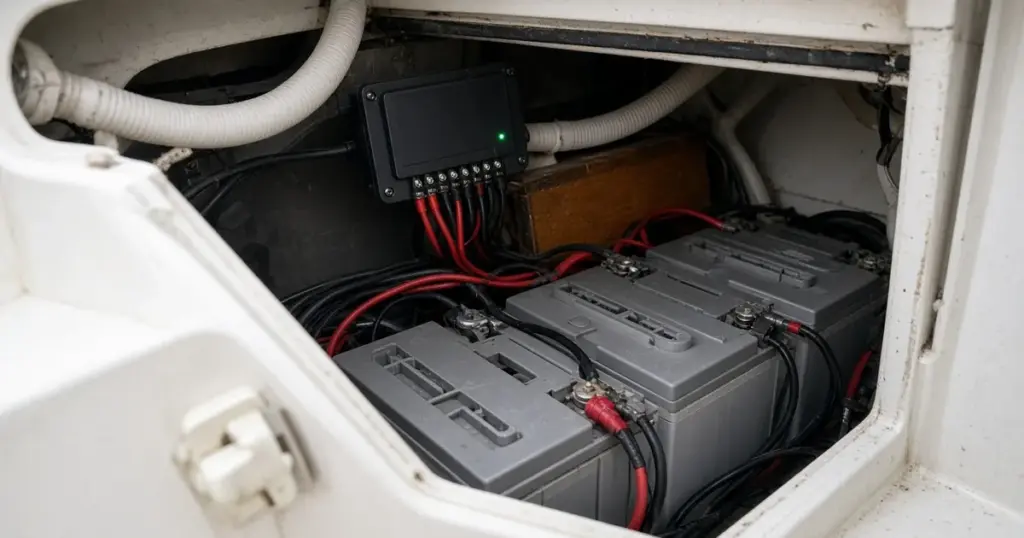
Every boat solar installation needs a charge controller between the panels and the batteries. The two main types, PWM and MPPT, both stop batteries from overcharging, but they handle panel power very differently. That difference can mean a meaningful amount of extra charging every day. This guide explains MPPT vs PWM charge controllers on boats and how to choose one.
What a charge controller does
Solar panels produce a voltage that varies with sunlight and temperature, often well above battery voltage. A controller:
- Regulates charging voltage and current to suit the battery.
- Applies charging stages such as bulk, absorption and float for lead-acid, or a lithium profile.
- Prevents batteries from discharging back through the panels at night.
- Often shows charging data on a display or app.
How PWM controllers work
A pulse-width modulation (PWM) controller is essentially a fast switch between the panel and the battery. When the battery needs charge, the switch connects them; as the battery fills, it pulses to hold the target voltage.
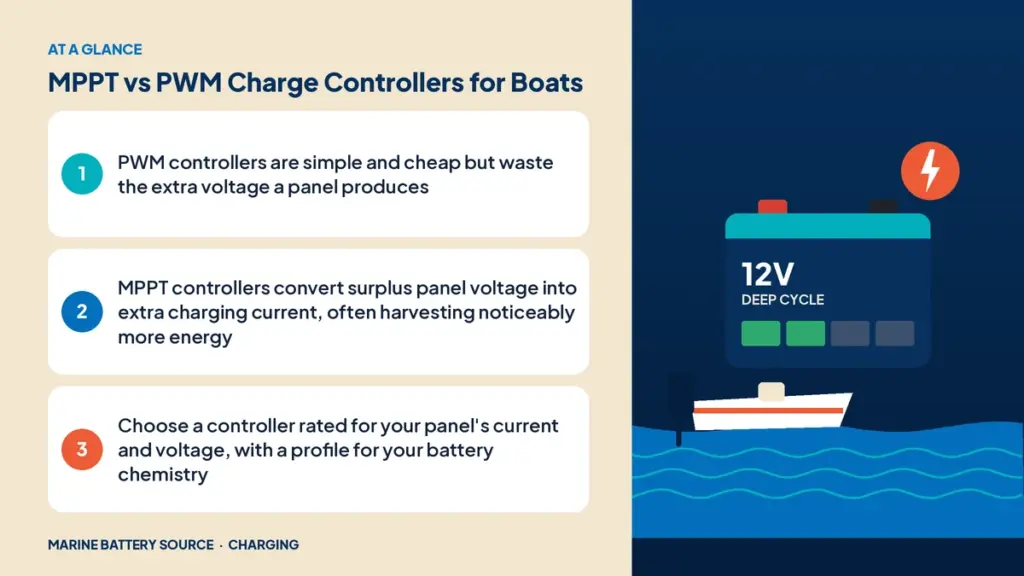
The catch: the panel is pulled down to battery voltage. A “12V” panel typically produces its maximum power at about 17V to 18V. Connected through a PWM controller to a battery at 13V, the extra voltage is simply lost. The panel delivers its current but not its full power.
Pros: low cost, simple, reliable, efficient enough for small systems where panel voltage closely matches the battery.
Cons: wastes a share of panel power; requires panels with voltage closely matched to the battery; can’t use higher-voltage panels or series strings.
How MPPT controllers work
A maximum power point tracking (MPPT) controller continuously finds the panel voltage and current combination that produces the most power, then converts that power to the battery’s voltage. Surplus voltage becomes extra current.
Example: a panel producing 100W at 18V and 5.5A. A PWM controller charging at 13V delivers roughly 5.5A, or about 72W. An MPPT controller, with about 95% conversion efficiency, delivers about 95W, or roughly 7.3A at 13V.
Pros: harvests more energy, especially in cool weather and with high-voltage panels; allows panels in series for thinner wires; works with residential-style panels.
Cons: higher cost; slightly more complex.
Comparison
| Feature | PWM | MPPT |
|---|---|---|
| Cost | Low | Moderate |
| Energy harvest | Lower | Higher, often by a meaningful margin |
| Panel voltage flexibility | Must match battery | Wide input range |
| Series panel strings | No | Yes |
| Best for | Small panels, maintenance | Most cruising and multi-panel systems |
When PWM makes sense
- A single small panel, perhaps 10W to 50W, maintaining a starting or trolling battery.
- Tight budgets where every dollar matters.
- Simple systems on trailered boats.
When MPPT makes sense
- Panels of 100W or more.
- Multiple panels, or series wiring to reduce cable size on long runs from an arch or bimini.
- Cold climates, where panel voltage rises and MPPT gains more.
- Lithium house banks on cruising boats.
Sizing a controller
- Current rating: for MPPT, divide total panel watts by battery voltage and add margin. 400W ÷ 12V ≈ 33A, so a 40A controller.
- Voltage rating: the maximum input voltage must exceed the panels’ open-circuit voltage in the coldest conditions, with margin.
- Battery voltage: confirm the controller supports 12V, 24V or higher as needed.
- Chemistry profiles: choose a controller with a lithium profile for lithium batteries.
See boat solar panel sizing for how to size the panels themselves.
Lithium compatibility
Lithium batteries need specific absorption voltages and no equalization. Many modern controllers include a LiFePO4 setting or allow custom voltages. Also check whether the controller should stop charging when the battery’s BMS disconnects for cold or high voltage. Heated lithium batteries help in cold climates.
Installation tips
- Mount the controller close to the batteries for accurate voltage sensing.
- Fuse between controller and battery, near the battery.
- Use a disconnect or breaker on the panel side for service.
- Keep it in a dry, ventilated location.
- Follow the maker’s order of connection; many require the battery to be connected first.
Solar for trolling batteries
On fishing boats, small panels often charge trolling batteries. For 24V or 36V banks, use a controller that supports that battery voltage, or charge each 12V battery separately. See solar for trolling motor batteries and charging trolling batteries while running.
Combining solar with other sources
Solar often works alongside wind, alternator and shore charging. Each source has its own regulator. Set them to compatible voltages so they don’t fight. See wind and hydro generators, charging on the water and charging lithium batteries on a boat.
Monitoring solar output
Many MPPT controllers report daily energy harvest through a display or Bluetooth app. Tracking that number for a few weeks shows how much your panels really produce in your conditions and whether shading or a loose connection is costing you. If harvest drops suddenly on a sunny day, inspect panel connections, fuses and the panel surface for dirt, salt or bird droppings.
A cost-benefit example
Suppose a cruiser has 300W of panels. In good sun, an MPPT controller might deliver about 90Ah per day, while a PWM controller with the same panels might deliver closer to 70Ah, depending on panel voltage and temperature. Over a season of weekends at anchor, that 20Ah per day adds up, and on a boat where solar is the main charging source, it can be the difference between running the engine every day or not. The MPPT controller’s higher price is often recovered in fewer engine hours and longer battery life.
Common mistakes
- Using a PWM controller with a high-voltage residential panel, wasting much of its output.
- Undersized controller current rating.
- Exceeding the controller’s maximum input voltage in cold weather.
- Forgetting the battery-side fuse.
Browse lithium batteries and house bank batteries in the store, or ask about battery accessories.
Frequently asked questions
Is MPPT worth it on a boat?
For systems of 100W or more, usually yes, because it harvests noticeably more energy.
Can I use a PWM controller with lithium batteries?
Yes, if it has a lithium profile or adjustable voltages.
What size charge controller do I need?
For MPPT, divide panel watts by battery voltage and add margin. Check the maximum input voltage too.
Can I connect solar panels directly to my battery?
Only tiny trickle panels. Anything larger needs a controller to prevent overcharging.