


ACR vs Battery Isolator vs DC-DC Charger
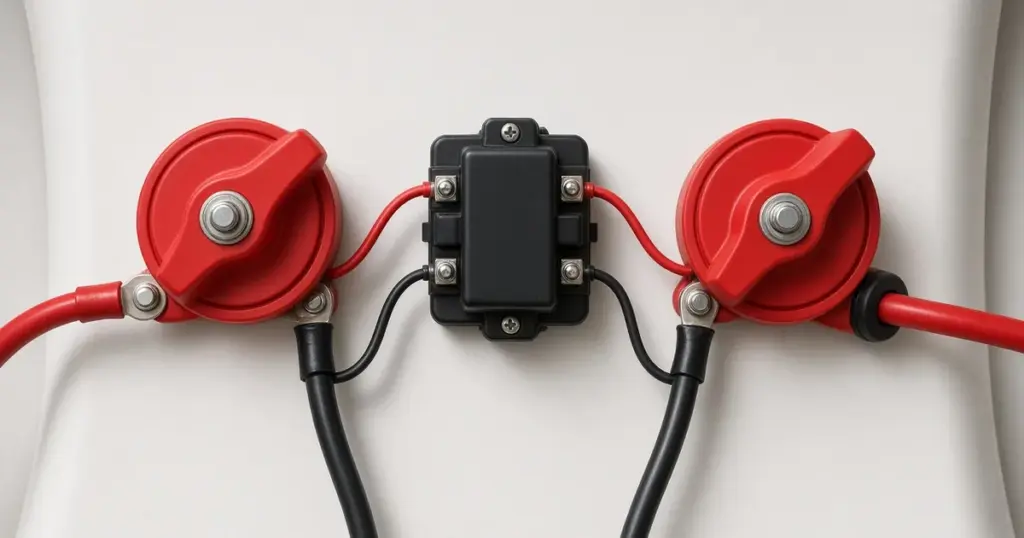
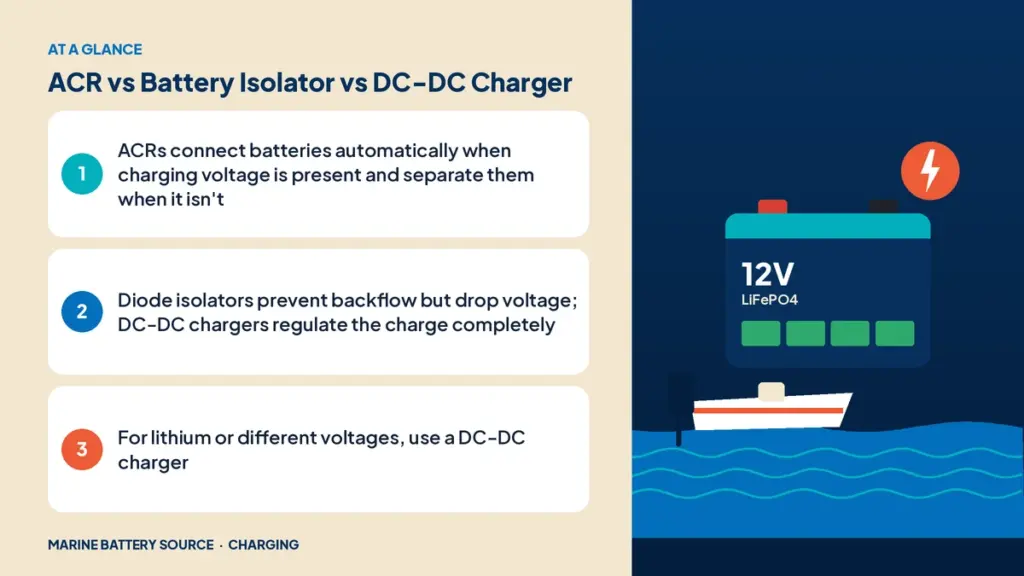
When a boat has more than one battery, the engine needs a way to charge all of them without letting one drain the others. There are three common devices for this: automatic charging relays (ACRs), battery isolators and DC-DC chargers. They look similar on a parts list but work very differently. This guide compares ACR vs isolator vs DC-DC charger so you can choose the right one.
The problem they solve
Your engine charges the starting battery. You also want it to charge a house, accessory or trolling battery. But when the engine is off, you don’t want accessory loads draining the starting battery. Each device connects batteries for charging and separates them when needed.
Automatic charging relay (ACR)
An ACR is a voltage-sensing relay. When it detects charging voltage on either battery, typically above about 13.0V to 13.3V, it connects the batteries so both charge. When voltage falls, it disconnects them.
Pros:
- Simple and inexpensive.
- Very little voltage drop when connected.
- Often bidirectional: it can combine batteries when either is charging, so a shore charger on the house bank can also charge the starting battery.
- Some include a manual combine for emergency starting.
Cons:
- Batteries are directly connected while charging, so they should share similar chemistry and charging voltages.
- Not suitable for most lithium plus lead-acid combinations.
- Doesn’t regulate current or apply different profiles.
Diode isolator
A diode isolator uses diodes to let current flow from the alternator to each battery but not back between batteries.
Pros:
- No moving parts and no switching.
- Batteries are always separated.
Cons:
- Diodes cause a voltage drop, often around 0.3V to 0.7V or more, which can undercharge batteries unless the regulator senses battery voltage or the isolator is a low-drop type.
- Generates heat.
- Doesn’t regulate profiles; not suitable for lithium.
Modern FET-based isolators reduce voltage drop, but the chemistry limitations remain.
DC-DC charger
A DC-DC charger draws from the starting battery or alternator and actively charges the second battery with its own profile, voltage and current limit.
Pros:
- Correct profile for lithium, AGM or flooded.
- Limits current to protect the alternator.
- Can step voltage up or down, such as 12V to 36V for trolling banks.
- Compensates for voltage drop on long cable runs.
Cons:
- Higher cost.
- Output limited by its rating.
- Some energy lost in conversion.
- Usually one-directional.
See what a DC-DC charger is for details.
Side-by-side comparison
| Feature | ACR | Diode isolator | DC-DC charger |
|---|---|---|---|
| Voltage drop | Very low | Moderate unless low-drop type | Regulated output |
| Different chemistries | No | No | Yes |
| Different voltages | No | No | Yes |
| Current limiting | No | No | Yes |
| Cost | Low | Low to moderate | Moderate to high |
| Typical use | Matched lead-acid banks | Older or simple systems | Lithium, trolling banks |
Which one should you use?
- Two AGM or flooded batteries, similar size, 12V: an ACR is simple and effective. Kits like the Dakota Lithium dual battery isolator kit package the hardware.
- Lithium house or trolling battery with a lead-acid starting battery: a DC-DC charger.
- 36V trolling battery from a 12V outboard: a step-up DC-DC charger such as the EPOCH 12V to 36V DC-DC charger.
- Existing diode isolator on an older boat: consider upgrading if batteries are chronically undercharged.
Combining with battery switches
ACRs and DC-DC chargers often work alongside a dual-battery switch, which lets you isolate, combine or turn off batteries manually. Keep switch positions in mind; combining lithium and lead-acid manually defeats the purpose of a DC-DC charger.
Solar and shore charging
At the dock, a multi-bank charger charges each battery directly. Some ACRs can combine banks when a shore charger or solar charges one of them. DC-DC chargers usually charge only one direction. Plan how each source reaches each battery. See boat solar panel sizing and charging on the water.
Wiring notes
- Fuse every positive cable at the battery.
- Size cables for the maximum current through the device.
- Mount the device in a dry, ventilated location.
- Follow the maker’s guidance on negative connections and trigger wires.
Trolling and cruising examples
- Bass boat: AGM cranking battery, lithium 36V trolling battery, 12V-to-36V DC-DC charger. See charging trolling batteries while running.
- Pontoon: two AGM batteries with an ACR.
- Cruising sailboat: lead-acid starting battery, lithium house bank, DC-DC charger or external regulator. See the liveaboard sailboat battery guide and alternator charging lithium.
Cost and complexity
An ACR is usually the least expensive and easiest to install: two battery cables, a ground wire and sometimes a remote switch. Diode isolators are similarly simple but less common in new installations. DC-DC chargers cost more and need more careful wiring, including properly sized input cables and sometimes an ignition trigger, but they replace the need for a separate lithium-safe charging solution underway. For many boats, the right choice is simply the cheapest device that suits the batteries’ chemistry and voltage.
Troubleshooting
- ACR clicking on and off: voltage hovering near the threshold, often from a weak battery or heavy loads.
- House bank never fully charged with an isolator: diode voltage drop; consider an ACR or DC-DC charger.
- DC-DC charger not turning on: trigger voltage not reached or ignition wire missing.
Upgrading an older boat
Older boats often have diode isolators or a manual switch left on “Both.” If your house batteries never seem fully charged, or your starting battery runs down at anchor, it may be time to upgrade. Replacing a diode isolator with an ACR is usually inexpensive for matched lead-acid batteries. If you’re also upgrading to lithium, skip straight to a DC-DC charger. In either case, inspect the cables and fuses at the same time, since old wiring often causes as many charging problems as the isolation device.
Browse chargers and DC-DC chargers in the store.
Frequently asked questions
What’s the difference between an ACR and an isolator?
An ACR is a relay that connects batteries when charging; a diode isolator always separates them but causes a voltage drop.
Can I use an ACR with lithium batteries?
Generally not with a lithium and lead-acid mix. Use a DC-DC charger instead.
Is a DC-DC charger better than an ACR?
For lithium or different voltages, yes. For matched lead-acid batteries, an ACR is simpler and cheaper.
Do I still need a battery switch?
A switch is useful for isolating batteries and emergency combining, alongside an ACR or DC-DC charger.