


Battery Maintainers vs Trickle Chargers for Boats

A boat that sits between trips or through the off-season slowly loses battery charge. Lead-acid batteries self-discharge, and small loads like stereo memory, bilge pump float switches and electronics drain them further. A battery maintainer prevents that, but not every “trickle charger” is the same. This guide explains the difference between battery maintainers and trickle chargers for boats, and how to keep both lead-acid and lithium batteries healthy in storage.
Why batteries need maintenance charging
- Self-discharge: flooded batteries can lose several percent of their charge per month, more in heat. AGM batteries lose less. Lithium loses very little.
- Parasitic loads: clocks, radio memory, alarms and electronics draw small currents that add up over weeks.
- Sulfation: lead-acid batteries left partially discharged form sulfate crystals that permanently reduce capacity.
- Freezing: a discharged lead-acid battery can freeze and crack in cold weather.
Trickle chargers
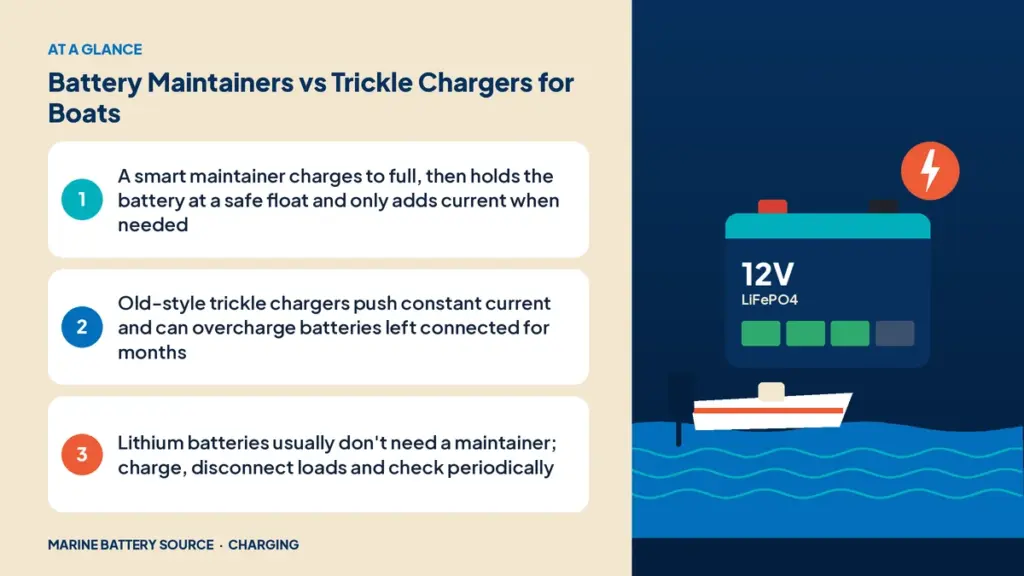
A traditional trickle charger delivers a small, constant current, often 1A or 2A, regardless of the battery’s state. If left connected indefinitely, it can keep pushing current into a full battery, causing overcharging, water loss in flooded batteries and drying out of AGMs. Some cheap units labeled “trickle chargers” are now smart, but the classic design isn’t.
Smart maintainers
A smart maintainer, sometimes called a float charger, monitors battery voltage. It charges the battery to full, then drops to a safe float voltage or turns off, only resuming when voltage falls. That makes it safe to leave connected for months. Many include multiple chemistry profiles and temperature compensation.
| Feature | Classic trickle charger | Smart maintainer |
|---|---|---|
| Current control | Constant low current | Varies with battery state |
| Safe for months | No | Yes |
| Chemistry profiles | Rarely | Often |
| Best use | Short top-ups | Storage and between trips |
Onboard chargers as maintainers
Most marine onboard chargers switch to a maintenance or float mode after charging, so they double as maintainers when the boat is plugged in. A multi-bank charger maintains every battery separately. See the onboard charger guide and the multi-bank charger guide.
Choosing a maintainer
- Match the chemistry: flooded, AGM or lithium.
- Choose a current suitable for the battery size: 1A to 5A for most marine batteries.
- Pick a weatherproof unit if it will stay near the boat.
- Use one maintainer per battery, or a multi-bank unit.
For a single battery, a small portable charger with a maintenance mode, like those compared in portable vs onboard chargers, also works.
Lithium batteries in storage
Lithium batteries self-discharge very slowly and generally don’t need continuous maintenance charging. Common guidance:
- Charge to the level the maker recommends for storage, often around 50% to 100%.
- Disconnect all loads with the battery switch, or disconnect the negative cable.
- Check state of charge every month or two and top up if needed.
- Avoid holding lithium at a high float voltage for months unless the maker approves.
- Store above the maker’s minimum storage temperature, and don’t charge below about 32°F unless the battery is heated.
See charging lithium batteries on a boat for more.
Mixed boats
On boats with a lead-acid cranking battery and a lithium trolling bank, maintain the cranking battery with a smart maintainer or onboard charger, and store the lithium bank charged and disconnected. Our guide to charging lithium trolling and lead-acid starting batteries covers this setup.
Off-season checklist
- Fully charge every battery.
- Turn the battery switch off or disconnect negatives.
- Connect smart maintainers to lead-acid batteries.
- Store in a cool, dry, ventilated place if the batteries come out of the boat.
- Check monthly: voltage, maintainer indicator lights and terminals.
Boats on lifts, moorings and docks
Boats left in the water or on lifts face different challenges: bilge pumps must stay powered, and batteries may be far from an outlet. A small solar panel with a charge controller can act as a maintainer. See charging on the water for solar options, and house bank sizing for larger cruising boats left at the dock.
Common mistakes
- Leaving a classic trickle charger connected all winter.
- Using a lead-acid maintainer profile on lithium.
- Forgetting the battery switch, so parasitic loads drain the battery faster than the maintainer replaces it.
- Running extension cords through puddles or wet areas.
How much current does a maintainer need?
Maintainers don’t need much power. A flooded battery losing 5% of 100Ah per month needs only about 5Ah per month, a tiny fraction of an amp on average. The maintainer’s rating matters mainly for recovering a battery that has already discharged. A 1A to 2A maintainer suits small batteries; 3A to 5A is better for larger batteries or several connected through a multi-output unit.
Batteries that store well
If your boat sits for long periods, battery choice affects how much maintenance it needs. Flooded batteries self-discharge fastest and need regular attention. Sealed AGM batteries lose charge more slowly and don’t need watering, which makes them easier to store. Lithium batteries lose very little charge in storage and suffer no sulfation, so a boat with lithium batteries and the switch turned off can often sit for months with only an occasional check. Before storage, top lithium up with a compatible charger such as the EPOCH 12V 15A lithium charger, then disconnect.
Storing batteries out of the boat
If you remove batteries for winter, store them on a shelf or a wooden pallet in a cool, dry, ventilated space away from living areas, heaters and sparks. Keep them upright, terminals covered, and out of reach of children and pets. Connect lead-acid batteries to maintainers there, and label each battery so it goes back in the right place in spring.
Spring wake-up
At the start of the season, give lead-acid batteries a full charge with a proper charger before launching, then load-test the starting battery. For lithium, top up to full and confirm the battery reports normal cell voltages in its app if it has one.
Browse marine chargers in the store.
Frequently asked questions
What’s the difference between a battery maintainer and a trickle charger?
A maintainer adjusts its output and stops or floats when the battery is full. A classic trickle charger supplies constant current and can overcharge.
Can I leave a maintainer on my boat battery all winter?
Yes, if it’s a smart maintainer designed for your battery chemistry.
Do lithium batteries need a maintainer?
Usually not. Charge them, disconnect loads and check periodically.
Will my onboard charger maintain my batteries?
Most onboard chargers switch to a maintenance mode after charging. Check your model’s manual.