


Portable vs Onboard Battery Chargers for Boats
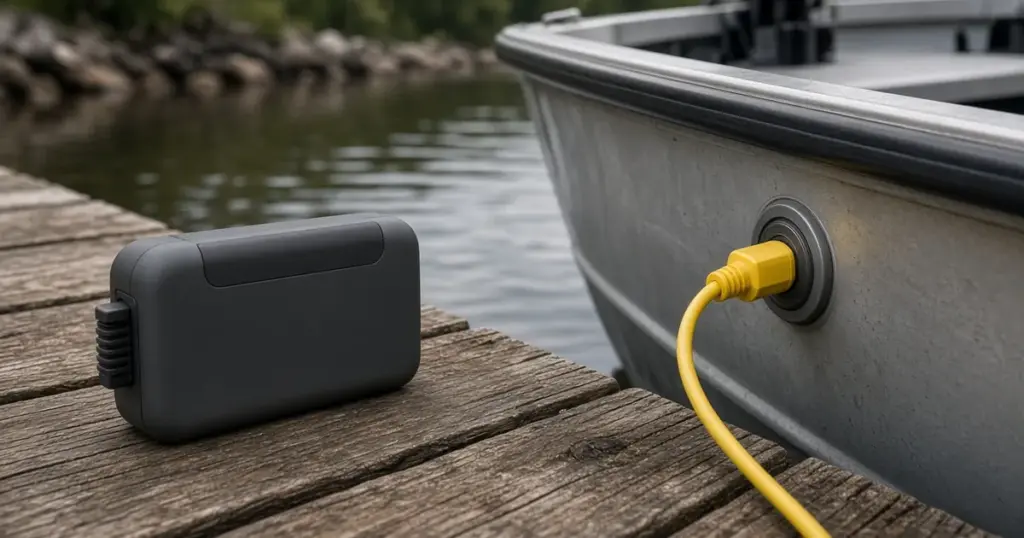
Every boat battery needs a charger, but there are two very different ways to get one aboard. A portable charger sits on a shelf until you clip it onto a battery. An onboard charger is bolted inside the boat and wired to every battery, so you just plug in a cord. This guide compares portable vs onboard battery chargers so you can decide which fits your boat, your batteries and how you use them.
What a portable charger is
A portable charger is a standalone unit with an AC cord and a set of clamps or ring terminals. You bring it to the battery, connect it, charge, and disconnect. Some portable chargers have two or more outputs, but most charge one battery at a time.
Strengths:
- Low cost.
- Can be used on boats, cars, trailers and spare batteries.
- No installation.
- Easy to replace or upgrade.
Weaknesses:
- You must open hatches and connect clamps every time.
- Charging several batteries means moving the charger or buying more than one.
- Clamps can slip, spark or corrode.
- Many portable chargers aren’t waterproof and shouldn’t live on a boat.
What an onboard charger is
An onboard charger is a sealed marine unit mounted permanently in the boat, with output cables wired to each battery and an AC cord or inlet. Most have two to four independent banks. Plug in, and every battery charges on its own profile. See the onboard charger guide for installation details.
Strengths:
- Plug-and-forget convenience.
- Charges every battery at once, each separately.
- Waterproof and vibration-resistant.
- Keeps batteries balanced in series trolling systems.
- Doubles as a maintainer during storage on many models.
Weaknesses:
- Higher upfront cost.
- Requires installation and space in the boat.
- Adds a few pounds.
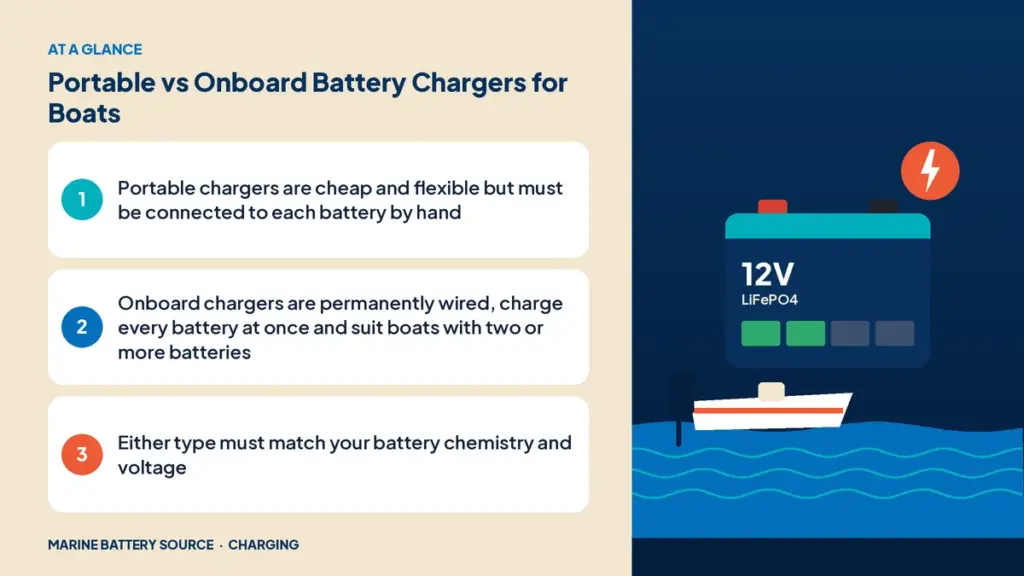
Side-by-side comparison
| Factor | Portable | Onboard |
|---|---|---|
| Typical cost | Low | Moderate to high |
| Batteries charged at once | Usually one | Two to four or more |
| Installation | None | Mounting and wiring |
| Weather resistance | Often limited | Sealed, marine-rated |
| Convenience | Manual connection each time | Plug in one cord |
| Best for | Single-battery boats, occasional use | Multi-battery boats, frequent use |
Which boats suit a portable charger?
- Kayaks, canoes and small boats with one removable battery.
- Boats where the battery comes home after each trip.
- Owners on a tight budget who charge occasionally.
- As a backup or for spare batteries.
A compact lithium charger such as the EPOCH 12V 15A lithium charger works well as a portable unit for a single 12V lithium battery.
Which boats suit an onboard charger?
- Bass and multi-species boats with 24V or 36V trolling systems.
- Pontoons and bay boats with starting and accessory batteries.
- Any trailered boat stored near an outlet.
- Boats that are used every weekend or more.
A multi-bank unit like the EPOCH 4-bank 12V charger handles a cranking battery and three trolling batteries. For a single 36V lithium trolling battery and a 12V cranking battery, a two-bank mixed-voltage charger is a cleaner fit.
Lithium compatibility
Whichever style you choose, the charger must have a lithium profile if you’re charging lithium batteries. Many older portable chargers have only flooded and AGM settings. For a mixed system, an onboard charger with per-bank profiles is the easiest way to charge lithium and lead-acid together. See charging lithium trolling and lead-acid starting batteries and charging lithium batteries on a boat.
Charge speed
Charge speed depends on amps, not on whether the charger is portable or onboard. A 15A portable charger charges a single battery just as fast as a 15A onboard bank. However, an onboard charger charges every battery at the same time, so the whole boat is ready sooner. See how long it takes to charge a marine battery.
Safety considerations
- Never leave a non-marine portable charger inside a closed boat compartment.
- Keep clamps from touching each other or the hull.
- Use a grounded, GFCI-protected outlet.
- Onboard chargers need fused DC outputs near each battery and ventilation for cooling.
Storage and maintenance
For off-season storage, both styles can keep batteries topped up if they have a maintenance mode. A dedicated maintainer is another option. See the battery maintainer guide.
Charging away from shore power
Neither charger works without AC power. On the water, alternators, DC-DC chargers and solar fill the gap. See charging on the water.
Cost over time
A portable charger costs less up front, but owners of multi-battery boats often end up buying several, plus clamps and extension cords, and they spend time connecting them after every trip. An onboard charger costs more initially but tends to extend battery life by charging each battery fully and consistently. For boats used often, that can offset the price.
A quick decision guide
- One battery you take home: portable.
- One battery that stays in the boat: small onboard or portable with a maintainer.
- Two or more batteries: onboard multi-bank.
- Mixed lithium and lead-acid: onboard with per-bank profiles, or separate chargers.
- Liveaboard or cruising boat: large onboard charger or inverter-charger.
Example: upgrading from portable to onboard
An owner with a 24V trolling system and a cranking battery has been using one portable charger, moving it from battery to battery over a weekend. The trolling batteries are often out of balance, and one fails early. Switching to a three-bank onboard charger means one plug-in after each trip, every battery fully charged and the trolling pair kept in balance. The portable charger stays in the garage for the car and a spare battery.
Browse marine chargers in the store.
Frequently asked questions
Is an onboard charger better than a portable one?
For boats with two or more batteries used regularly, yes. For a single removable battery, a portable charger is often enough.
Can I leave a portable charger on my boat?
Only if it’s rated for marine use. Most portable chargers aren’t sealed and shouldn’t stay aboard.
Do onboard chargers charge faster?
Not per battery at the same amp rating, but they charge every battery at once, so the boat is ready sooner.
Can a portable charger charge lithium batteries?
Yes, if it has a lithium profile. Check before using an older charger on lithium.