


IP67 and Waterproof Ratings for Marine Lithium Batteries
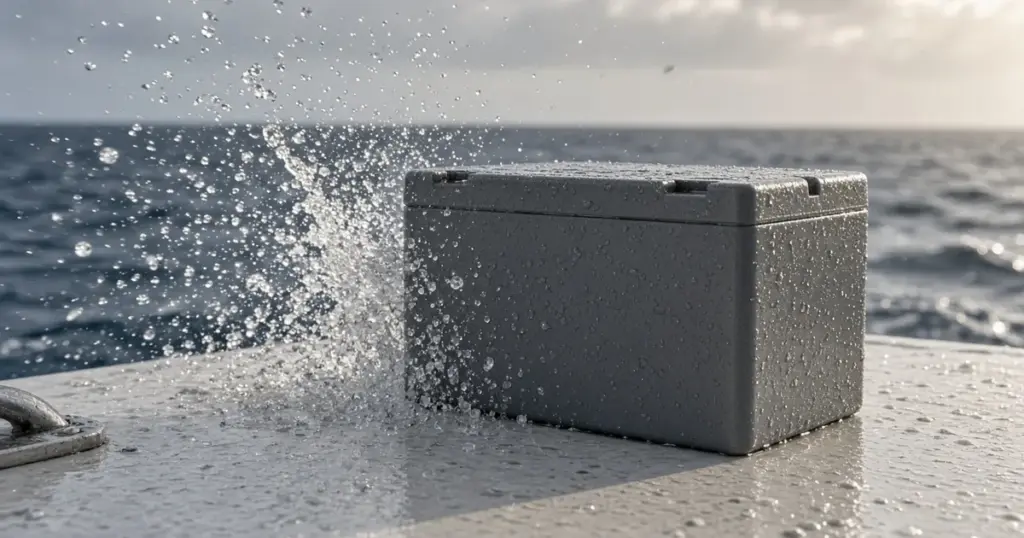
Marine lithium batteries often carry labels like IP65, IP67 or simply “waterproof.” Those labels matter on a boat, where batteries live in damp compartments and catch spray from washdowns and rough water. But IP ratings are frequently misunderstood. This guide explains what IP67 and other ratings mean for a marine lithium battery, what they don’t promise, and how to keep the parts the rating doesn’t cover, like terminals and cables, in good shape.
What an IP rating is
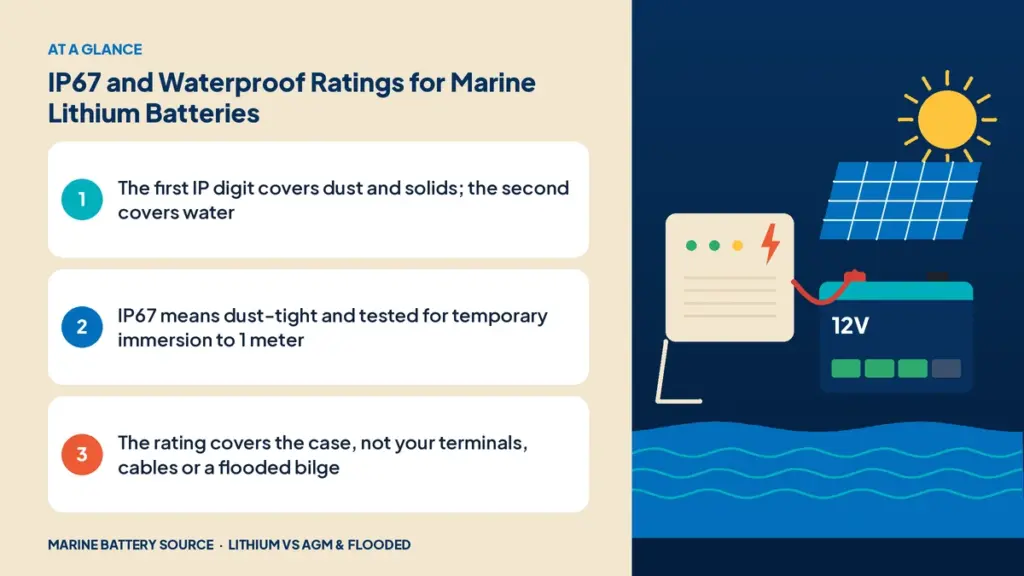
IP stands for ingress protection. The code comes from the international standard IEC 60529, which defines how well an enclosure keeps out solids and liquids. An IP rating has two digits:
- First digit (0–6): solids, from no protection to fully dust-tight.
- Second digit (0–9): water, from no protection to high-pressure, high-temperature water jets.
The water digits that matter on boats
| Second digit | Protection against | What it means in practice |
|---|---|---|
| 4 | Splashing water from any direction | Rain and splashes |
| 5 | Water jets | Hose spray |
| 6 | Powerful water jets | Heavy spray and green water |
| 7 | Temporary immersion to 1 meter, typically 30 minutes | A brief dunking |
| 8 | Continuous immersion beyond 1 meter, as specified by the maker | Conditions set by the manufacturer |
A first digit of 6 means dust-tight. So IP67 means dust-tight and protected against temporary immersion. IP66 means dust-tight and protected against powerful jets. Note that the immersion and jet tests are separate; a battery rated IP67 hasn’t necessarily been tested against high-pressure jets unless it carries both ratings.
IP67 batteries in the store
Several marine lithium options list an IP67 rating, including:
- Lithium Rhino’s marine conversion kits, such as the Lithium Rhino 36V 120Ah IP67 kit and the Lithium Rhino 12V 120Ah dual cranking kit.
- The ECO Battery 12V 120Ah heated Bluetooth battery.
Other brands describe their cases as sealed or waterproof without publishing an IP code on the listing. Check the manufacturer’s spec sheet when water resistance matters for your installation.
What IP67 doesn’t mean
It’s not a license to submerge
IP67 testing is a short-duration immersion under defined conditions. It doesn’t mean the battery should sit in a flooded bilge or live in standing water. Saltwater, heat cycles and pressure changes in a real boat are harsher than a lab test.
It doesn’t cover your terminals
The rating applies to the enclosure. Exposed terminals, lugs and cable ends are outside it. Salt spray on terminals causes corrosion, and seawater bridging the terminals can cause current leakage or a short.
It doesn’t replace good installation practice
Mount batteries high enough to stay out of bilge water, in a ventilated compartment, secured against movement and with fused positive cables.
It doesn’t say anything about vibration or impact
Those are separate tests. Pounding through chop is its own stress, so secure mounting matters regardless of IP rating.
Protecting what the rating doesn’t cover
- Terminal boots: cover positive terminals to prevent shorts and keep spray off.
- Protectant: apply a terminal protectant after tightening, and reapply during regular inspections.
- Tinned marine cable and sealed lugs: tinned copper resists corrosion, and adhesive-lined heat shrink seals the joint between cable and lug.
- Corrosion-resistant hardware: use stainless or the hardware the battery maker supplies, and don’t mix dissimilar metals carelessly.
- Drain and dry: keep battery compartments drained, and check them after heavy rain or rough days.
Why water resistance matters more with electronics inside
A lithium battery contains a BMS, sensors and, on some models, Bluetooth and heater circuits. Moisture and salt are bad for electronics. A well-sealed case protects those parts. If a battery ever does get submerged, disconnect it, dry the area and contact the maker before returning it to service. Our BMS guide explains what those electronics do.
Choosing a battery for wet locations
- Open boats, kayaks and skiffs: batteries often sit in exposed spots. Look for a published high IP rating and protect terminals carefully.
- Center consoles and bay boats: consoles and stern compartments see spray and occasional water intrusion. A sealed, rated case adds margin.
- Enclosed hulls and cruisers: batteries usually live in drier compartments, but condensation and bilge water are still risks.
Condensation: the quiet water problem
Even in a dry compartment, temperature swings cause condensation. A hull that cools overnight and warms in the morning sun can leave a film of moisture on battery tops and terminals. On a saltwater boat, that moisture carries salt residue, and over months it builds into the white or green crust you see on neglected terminals. A sealed, rated battery case keeps that moisture out of the electronics, but the outside still needs attention. Wipe battery tops during routine checks, make sure compartment drains are clear, and leave enough airflow that the space can dry out. Avoid wrapping batteries in plastic bags or sealed covers, which trap moisture against the terminals rather than keeping it out.
Lead-acid and water
Flooded lead-acid batteries have vents and removable caps, so they’re not water-resistant at all; water intrusion dilutes electrolyte and contaminates cells. AGM batteries are sealed but still vent through valves. If water resistance is a priority, sealed lithium with a published rating is the strongest option. See lithium myths for the “lithium can’t handle saltwater” claim.
Warranty and water damage
Read the warranty for how water exposure is treated. Some makers exclude damage from submersion or improper installation even on rated batteries. Our warranty guide explains common exclusions, and the drop-in replacement checklist covers installation steps that keep batteries dry.
For other buying criteria, see the lithium marine battery buyer’s guide, or compare rated models in the store’s Lithium Rhino range and the full lithium lineup.
Frequently asked questions
What does IP67 mean on a lithium battery?
It means the enclosure is dust-tight (6) and protected against temporary immersion in water up to 1 meter under test conditions (7).
Can an IP67 battery sit in bilge water?
It shouldn’t. IP67 covers short immersion in testing. Mount batteries above bilge water and keep compartments drained.
Is IP67 better than IP66?
They test different things. IP67 covers temporary immersion, while IP66 covers powerful water jets. Some products carry both ratings.
Do I still need to protect terminals on an IP67 battery?
Yes. The rating covers the case, not exposed terminals and cable ends. Use boots, protectant and sealed lugs.