


How to Size Solar Panels for Your Boat
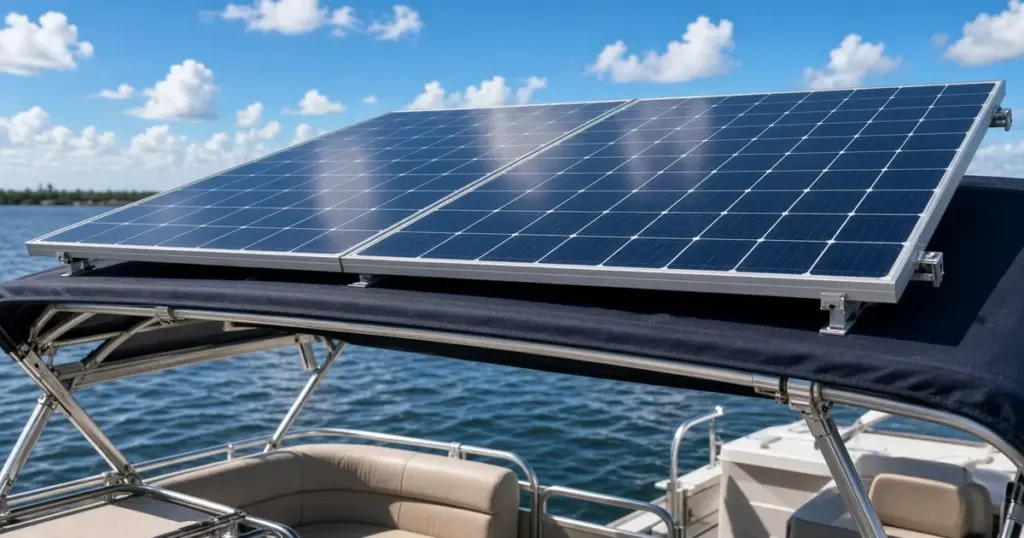
Solar panels are one of the most popular upgrades for boats. They’re silent, maintenance-free and work whenever there’s daylight, whether you’re at anchor, on a mooring or sitting on a lift between trips. But many boaters buy panels that are too small to matter, or install them where shade cuts their output in half. This guide explains boat solar panel sizing from a daily energy budget, with realistic output numbers and example systems.
Step 1: Estimate daily energy use
Add up the amp-hours each load uses per day:
| Load | Draw | Hours per day | Ah per day |
|---|---|---|---|
| 12V refrigerator | 4A average | 24 | 96 |
| LED cabin lights | 2A | 4 | 8 |
| Electronics | 3A | 6 | 18 |
| Anchor light | 0.5A | 10 | 5 |
| Phone and tablet charging | 2A | 3 | 6 |
| Total | 133Ah |
For trailered fishing boats, the goal might be only maintaining batteries or replacing part of a trolling day. For cruisers, the goal may be covering most daily use at anchor. Our guide to charging on the water explains how solar fits with other sources.
Step 2: Estimate realistic panel output
A panel’s rated wattage is measured in ideal lab conditions. On a boat, real output is lower due to sun angle, heat, shading and wiring losses. A practical rule of thumb:
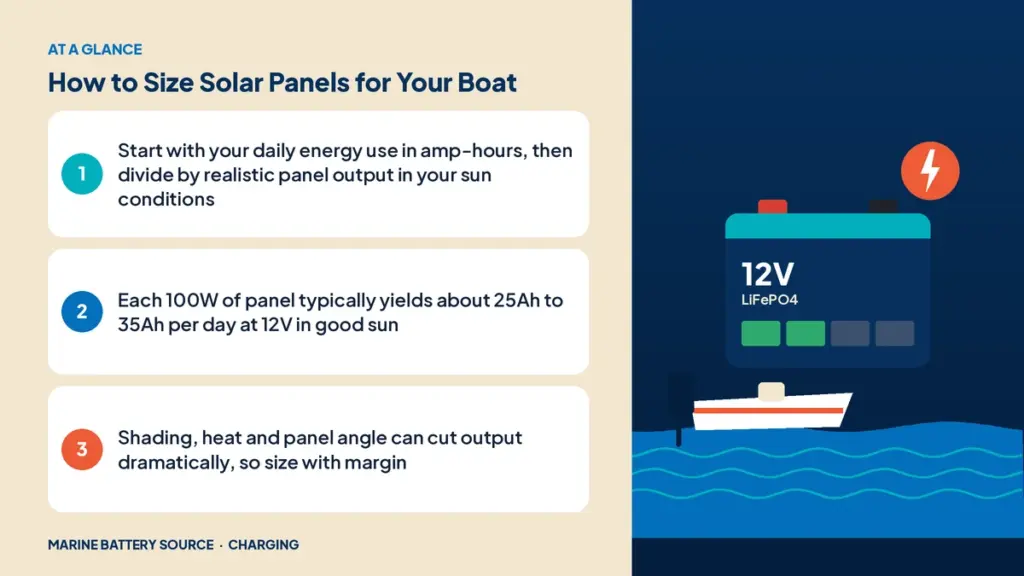
- Each 100W of panel produces about 25Ah to 35Ah per day at 12V in good sun, with an MPPT controller.
- Expect less in winter, at higher latitudes, in cloudy weather or with any shading.
- In sunny southern waters, output trends toward the upper end; in northern spring and fall, toward the lower end.
Step 3: Calculate panel size
Panel watts ≈ (daily Ah ÷ Ah per 100W) × 100
Example: to cover 133Ah per day at 30Ah per 100W: 133 ÷ 30 × 100 ≈ 440W. Round up to 450W to 500W to allow for cloudy days and aging. For partial coverage, size to what you want solar to supply, and let the engine or generator supply the rest.
Shading: the biggest output killer
Boats are full of shade: masts, booms, radar arches, antennas, T-tops and people. Partial shading of even one cell in a panel can cut its output substantially. Tips:
- Mount panels where they’re unshaded most of the day.
- Use multiple smaller panels on separate controller inputs or wired to minimize shading losses.
- Consider panels with bypass diodes.
- On sailboats, expect boom and sail shading underway.
Panel types
| Type | Pros | Cons |
|---|---|---|
| Rigid glass panels | Efficient, durable, affordable | Heavier, need a frame or arch |
| Semi-flexible panels | Light, conform to curved surfaces | Run hotter, often shorter life |
| Portable folding panels | No installation, can be aimed | Must be stowed and secured |
Charge controllers
Panels connect to batteries through a charge controller. MPPT controllers harvest more energy, especially with higher-voltage panels and in cool conditions; PWM controllers are cheaper and suit small systems. Choose a controller with a lithium profile if you have lithium batteries. See MPPT vs PWM controllers.
Battery capacity and solar
Solar can only store what your batteries can hold. A 500W array producing 150Ah on a sunny day needs a bank with enough usable capacity to absorb it. Lithium banks make better use of solar because they accept charge efficiently at any state of charge. A 300Ah lithium house battery like the EPOCH 12V 300Ah Essential provides about 3.8 kWh of storage for a mid-size solar system.
Example systems by boat type
- Bass boat or bay boat: a 50W to 100W panel maintains batteries between trips and adds some charge to a trolling battery. See solar for trolling batteries.
- Pontoon on a lift: 100W to 200W on the bimini maintains starting and accessory batteries and the bilge pump.
- Weekend cruiser: 200W to 400W to cover a fridge and lights at anchor.
- Liveaboard sailboat: 400W to 800W or more, combined with wind and engine charging. See the liveaboard sailboat guide.
Wiring tips
- Fuse between the controller and battery, close to the battery.
- Use tinned marine wire sized for low voltage drop.
- Seal deck penetrations properly.
- Secure panels against wind and wave loads.
- Use a disconnect so panels can be isolated for service.
Combining solar with engine charging
On trailered boats, solar is usually a supplement to shore and engine charging. A DC-DC charger tops up batteries while running; solar adds while sitting. See charging trolling batteries while running and ACR vs isolator vs DC-DC for how sources share batteries.
Worked example: a weekend cruiser
A 30-foot cruiser at anchor uses about 90Ah per day, mostly for a fridge and lights. The owner has room for two 200W rigid panels on the hardtop, about 400W in total. At around 30Ah per 100W, that’s roughly 120Ah per sunny day, which covers daily use with some margin. On cloudy days, output might fall to 40Ah to 60Ah, so the owner runs the engine for an hour or uses shore power when available. A 300Ah lithium house bank gives three days of reserve.
Common sizing mistakes
- Using rated watts without accounting for real-world losses.
- Ignoring shade from T-tops, masts and antennas.
- Undersizing wire, which loses a meaningful share of output.
- Pairing a large array with a small battery bank.
Seasonal and regional differences
Solar output varies a lot through the year. A panel that keeps up with a fridge in a Florida summer may fall short in a northern October, when the sun is lower and days are shorter. If you cruise in different seasons or regions, size for the toughest conditions you expect, or plan for the engine or generator to cover shortfalls. Heat also matters: panels lose some efficiency when very hot, so airflow behind rigid panels helps.
Browse house bank batteries and lithium batteries in the store.
Frequently asked questions
How many watts of solar do I need on my boat?
Divide your daily amp-hours by about 25 to 35, then multiply by 100 for the panel watts needed in good sun.
Will a 100W solar panel keep my boat battery charged?
For maintenance and small loads, usually yes. It typically produces about 25Ah to 35Ah per day in good sun.
Do I need a charge controller?
Yes. A controller regulates charging and prevents overcharging. Choose one with the right battery profile.
Are flexible solar panels good for boats?
They’re light and fit curved surfaces, but they often run hotter and may not last as long as rigid panels.