


Charging Trolling Motor Batteries from Your Outboard While Running
Tournament anglers and long-day fishermen often ask the same question: can the big outboard put some charge back into the trolling batteries between spots? It can, with the right equipment. This guide explains how to charge trolling motor batteries while running, what equipment you need, and how much charge to realistically expect.
How it works
The outboard’s charging system charges the starting battery. A device between the starting battery and the trolling bank shares some of that output:
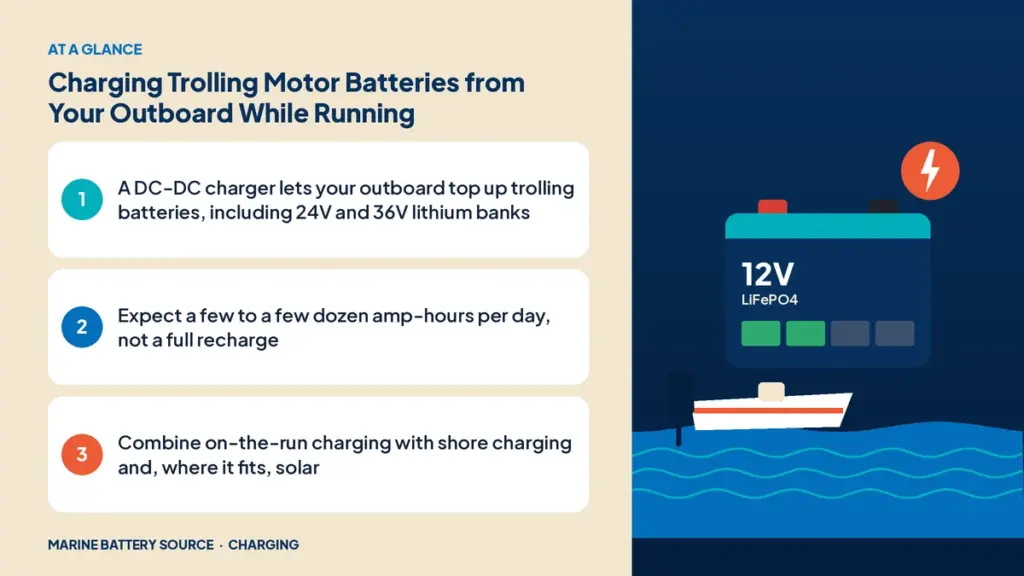
- DC-DC charger: the modern standard. It regulates voltage and current, applies the trolling bank’s charge profile and can step 12V up to 24V or 36V.
- ACR or isolator: for 12V lead-acid trolling batteries of the same chemistry as the starting battery. Not suitable for 24V or 36V series banks without additional hardware, or for lithium.
For most modern setups, especially lithium, a DC-DC charger is the right choice. See ACR vs isolator vs DC-DC charger.
Step-up DC-DC chargers for 24V and 36V
A 36V trolling system can’t be charged directly by a 12V outboard. A step-up DC-DC charger takes 12V input and produces a 36V charging output. Examples:
- EPOCH 12V to 36V DC-DC charger: single output, IP67.
- EPOCH dual-output 12V/36V DC-DC charger: separate 12V and 36V outputs for boats with a 12V accessory battery too.
These chargers work best with a single 36V lithium trolling battery. For three 12V batteries in series, check the charger’s guidance; balancing usually still relies on a multi-bank shore charger.
How much charge to expect
The limiting factors are the outboard’s spare charging output, the DC-DC charger’s rating and how long you run.
Example: a DC-DC charger drawing about 30A from a 12V system delivers roughly 9A to 10A into a 36V battery after conversion losses. A 20-minute run adds about 3Ah to the 36V battery; two hours of running across a day adds around 18Ah to 20Ah. That can be the difference between finishing the day or not, but it won’t replace a full day of heavy trolling.
| Daily running time | Approx. added to 36V battery (10A output) |
|---|---|
| 30 minutes | 5Ah |
| 1 hour | 10Ah |
| 2 hours | 20Ah |
| 3 hours | 30Ah |
Check your outboard’s charging output. Smaller engines have less spare capacity, and the starting battery and electronics need some of it.
Starting battery protection
DC-DC chargers turn on only when they detect charging voltage or an ignition signal, so they don’t drain the starting battery when the engine is off. Make sure the trigger is set correctly and that the starting battery stays healthy. Our guide to alternator charging lithium explains why the starting battery acts as a buffer.
Installation steps
- Mount the DC-DC charger in a dry, ventilated compartment near the batteries.
- Run the input from the starting battery positive through a fuse within a few inches of the battery.
- Run the output to the trolling battery positive through a fuse near that battery.
- Size the input cable for the higher current on the 12V side.
- Connect negatives as the manufacturer directs.
- Connect an ignition trigger wire if needed.
Adding solar
Solar complements on-the-run charging. A flexible panel on a console or a rigid panel on a T-top can add charge while you fish and while the boat sits between trips. See boat solar panel sizing, MPPT vs PWM controllers and solar for trolling batteries.
Shore charging is still essential
On-the-run charging is a supplement. You’ll still need an onboard or portable charger to fully recharge the trolling bank after each day. See charging on the water for an overview of every charging source, and charging lithium batteries on a boat for lithium specifics.
Lithium vs lead-acid for on-the-run charging
Lithium batteries accept charge at full current until nearly full, so every minute of running counts. Lead-acid batteries accept less current as they approach full and are typically charged with ACRs at 12V. If on-the-run charging matters to you, lithium and a DC-DC charger are the most effective combination.
A sample tournament day
Picture a day with a 30-minute run to the first spot, five moves of 10 to 15 minutes each, and a 30-minute run back to weigh-in. That’s roughly two hours of running. With a step-up charger delivering about 10A into a 36V lithium battery, the trolling battery gains around 20Ah over the day. If the trolling motor used 70Ah, the battery ends the day at roughly 50Ah net use instead of 70Ah, which may be the margin that lets you fish hard through the final hour.
Common mistakes
- Using a 12V ACR to “charge” a 36V series bank.
- Undersized input cables causing low output.
- No input fuse at the starting battery.
- Expecting a full recharge from short runs.
- Letting the starting battery run low because of heavy electronics loads.
Tournament tips
- Charge everything fully the night before.
- Run with electronics and livewells managed to keep the starting battery healthy.
- Use the DC-DC charger on every run between spots.
- Track state of charge with the battery’s Bluetooth app if available.
- Recharge fully at the end of each day.
Is it worth the investment?
For anglers who regularly run out of trolling power late in the day, a DC-DC charger is one of the most cost-effective upgrades, often cheaper than moving to a larger battery. It’s also useful insurance for long days far from the ramp. For anglers who rarely use more than half their trolling capacity, it may not be necessary. Look at your actual usage first: a battery app or monitor tells you how much capacity you have left at the end of a typical day, and that answers the question.
Browse trolling motor batteries in the store.
Frequently asked questions
Can my outboard charge my trolling motor batteries?
Yes, through a DC-DC charger, which also steps voltage up for 24V or 36V systems.
How much charge will I get while running?
Depending on the charger and outboard, roughly 5Ah to 10Ah per hour of running into a 36V battery is common.
Do I need a DC-DC charger for lithium trolling batteries?
Yes, it’s the recommended way to charge lithium from an outboard.
Will charging trolling batteries drain my starting battery?
Not with a correctly installed DC-DC charger, which only operates when the engine is charging.